Showing posts with label Battle of Omdurman. Show all posts

Tuesday, April 5, 2022

The Neo-Confederate Gambit

 You know the expression “never meet your heroes”? Well, I think there needs to be an addendum to that advice – never follow your heroes on twitter. Readers may be familiar with Professor Phillips O’Brien but for those who are not, he is Professor of Strategic Studies at the University of St Andrews. He’s also an extremely capable historian who has written one of the best books on the Second World War in recent years. If you haven’t read How the War Was Won go and buy a copy. It is revisionist history at its finest.

Buy this book

Alas, an expertise on logistics and machinery doesn’t translate into expertise in other areas. At the height of the summer of Floyd in 2020 Professor O’Brien wrote a series of tweets about the issues of race and the historian’s fallacy.

O’Brien starts with summarising the two main opposite opinions – on the one hand we shouldn’t judge Churchill’s antiquated views on race because “racist views were dominant” during his life, in O’Brien’s words. On the other hand, Churchill was an “out and out racist” and basically no better than Hitler.  O'Brien doesn't agree with the latter view but spends no time debunking it. Instead he mainly criticises the former viewpoint. He says that “no era was simply racist – there was always a range of opinion and it’s important to look at the individual within the context of that range”. This is missing the point. No one has ever claimed that there was 100% unanimous consensus pre-1965 that white Europeans were superior to black Africans or brown Asians. Such a degree of unanimity on any issue at any time has probably never existed. It doesn’t mean though that the 19th century or the first half of the 20th century were not eras in which a preponderance of white people likely held racist views.

For an analogy, there were unquestionably atheists in France in the 14th century. Does it follow that 14th century France was not therefore a very religious society compared to 21st century France? Of course not.

It borders on negationism to suggest otherwise. Yes, there were a number of white people in the 19th century who held egalitarian views on race, comparable to mainstream attitudes today. But in how many places in the 19th century did whites and blacks live as political, legal or social equals? I’m not going to enumerate them all but the answer will be somewhere between no where and very few places.

Suppose a pollster could travel back to the 1870s and ask random white people in Europe, the United States or any European settler colony for their opinion on racial issues. It is likely that the comments they would have recorded would have included something on the lines of:

• Race is a biological phenomenon. 

• Differences in attainment reflected largely inherent differences in race or ethnicity.

• Civilised societies were a product of characteristics which, if not unique to white Europeans, were found in far greater number among those of European stock compared to those of Sub-Saharan African stock.

• It was not unreasonable for white societies to protect themselves by controlling either the numbers of people of colour, or limiting their rights and freedoms.

O’Brien’s example – white society in the United States in the Civil War – doesn’t prove his point at all. In fact, it shows just how widespread racist ideals were in the mid-19th century. O’Brien highlights radical abolitionists like Thaddeus Stevens as evidence that there was a “huge variety of views on race”. But according to the leading historian of the period, Eric Foner, Thaddeus Stevens represented a minority opinion. Stevens’s biographer, Bruce Levine, goes further and describes radical abolitionists like Stevens as a “widely despised handful”. Ironically, many people at the time thought that Stevens himself was a bigot against other white folks – white Southerners. Not only that, but Steven’s reputation plummeted after his death. For about 70 years white Americans regarded him as the worst person their nation had ever produced, with the possible exception of Benedict Arnold!

On the other hand, the reputation of Robert E. Lee, the Confederate General, soared even in the north. So much so that by the middle of the 20th century a US president of Pennsylvanian Dutch origin who grew up in Kansas considered him one of the four greatest Americans of all time. The fact that Lee was a slaveholder was unimportant. 


In his age, Thaddeus Stevens was an extreme outlier. In selecting him to downplay racism in white-American society during the 1860s, Professor O’Brien sounds like a Neo-Confederate. The type who cherry pick examples of African-Americans who fought for the Confederacy to pretend the Confederacy was not fighting to sustain slavery. Or who cherry pick one or two quotes by Robert E. Lee to portray him as an abolitionist. It isn’t convincing.

Professor O’Brien then moves on to Abraham Lincoln, and credits him as an example of someone who “evolve[d] in interesting and enlightening ways”. This apparently proves that his age wasn't simply a racist one. However, O'Brien is silent on what exactly Lincoln’s evolution involved. Lincoln, for most of his life, was an extreme racist by our standards who would make someone like Richard Spencer look tame. In 1858 in the debates with Stephen Douglas, Lincoln famously said:

“I will say then that I am not, nor ever have been in favor of bringing about in any way the social and political equality of the white and black races—that I am not nor ever have been in favor of making voters or jurors of negroes, nor of qualifying them to hold office, nor to intermarry with white people; and I will say in addition to this that there is a physical difference between the white and black races which I believe will for ever forbid the two races living together on terms of social and political equality. And inasmuch as they cannot so live, while they do remain together there must be the position of superior and inferior, and I as much as any other man am in favor of having the superior position assigned to the white race.”

In 1862 he told a delegation of African Americans visiting the White House that it would be better if African Americans packed their bags and left:

“You and we are different races. We have between us a broader difference than exists between almost any other two races. Whether it is right or wrong I need not discuss, but this physical difference is a great disadvantage to us both, as I think your race suffer very greatly, many of them by living among us, while ours suffer from your presence. In a word we suffer on each side.”

This sounds extreme to us, but it is worth bearing in mind that when most American abolitionists called for the end of slavery, they did not have in mind that slave owners and former slaves would sit down together at the table of brotherhood. They wanted to deport (or "repatriate") all African-Americans from the United States to Africa. They didn’t like slavery, but the idea of racial equality was no less revolting to them as it was to an antebellum slaveholder away down south in Dixie. 

Now it is true that Lincoln didn’t remain of that view forever. As Professor O’Brien says, he “evolved”. But this evolution only went so far as one speech made in 1865 saying that some (not all) African-Americans should be given the vote. In other words, he remained a virulent racist by our standards.

The point I am trying to make is not that I think Lincoln was an awful human being. It is that, while he was maybe enlightened and progressive by the standards of the 1860s, he falls very short of the standards of the 2020s. 

Another example O’Brien cites is FDR, who was “not just a creature of his time”. While he concedes that FDR was “racist in [his] own way” he credits him with using “his power to try and do some good”. I also admire FDR, but there is no getting around the fact that he rounded up an entire ethnic group and detained them in internment camps on the basis of little evidence. Is this an example of “some good” he tried to do? Why does FDR get a pass?

With that out of the way, let’s move onto Churchill. O’Brien characterises him as “pretty terrible” by the standards of his era, who was “consistently one of the more aggressive and oppressive racists” of his age, who tolerated war crimes in South Africa and Sudan and believed in a racial hierarchy with Anglo-Saxons at the top.

This is just plain wrong. I don’t understand how O’Brien can bring up Churchill’s experience in Sudan and completely omit the fact that Churchill was appalled by British atrocities against wounded Dervishes. He ignores Churchill’s experience at the Colonial Office and how he was a consistent opponent of brutality against colonised subjects. O'Brien brings up the Irish, but Churchill didn't really harbour any  strong prejudice against the Irish and came around to support Home Rule and even the unification of Ireland. 

More curiously though is O’Brien’s total omission of Churchill’s attitude to Jews. Jews were among the biggest victims of racism during Churchill’s lifetime so you’d think they would merit a mention. There were many single massacres of Jews in WW2 in which more Jews were murdered than Irish people (both armed Republicans and civilians) died during the entire Anglo-Irish War. Churchill, as is well known, was a consistent opponent of anti-Semitic discrimination and supporter of Zionism. So much so that it struck his contemporaries as unusual (“Winston had one fault. He was too fond of Jews”, as one of them said to Sir Martin Gilbert). 

Churchill’s opposition to Indian independence was not unique at all, although the manner of his opposition set him apart from the Conservative party. Concessions to India in the 1930s (which Churchill opposed) were not seriously intended to advance India to independence but instead represented a bait and switch to keep India in the Empire for years. This has been known since Carl Bridge published Holding India to the Empire in 1986.

O’Brien then writes that we shouldn’t look at historical figures as though we were putting together a “balance sheet”. The thing with balance sheets though is that they have to provide a true and fair view of the financial position of an organisation. If you were to use that analogy for historical figures, you have to accurately reflect what those figures said a did and you have to mention the positive things Churchill did and thought along with the negative. You also need to provide appropriate weighting for them. It matters more that Churchill criticised the Amritsar massacre than it does that he made a joke at a dinner party about Gandhi being trampled to death by elephants, for example. 

In summary, to suggest that the period of 1874 – 1965 wasn’t extremely racist by today’s standards borders is absurd and borders on denialism. It is not unreasonable to deplore Churchill’s attitudes on race (or other subjects) but to ignore the milieu in which they developed is ahistorical. To claim that Churchill was an extremist in his own time is simply wrong.

Thursday, June 10, 2021

Hirsch to Hari via Omdurman

In May 2018, Afua Hirsch was invited onto Good Morning Britain to opine about Winston Churchill. Neither she nor the co-host of the show, Piers Morgan, are historians. However, they are perfectly qualified to talk about Churchill in the current milieu. You see they have strident views and they both get people riled up. And if a discussion about Churchill is not aiming to generate clicks and outrage, what even is the point in discussing him?

Hirsch disagrees with people who admire Churchill. She claims that he was a more fascinating character than the “cardboard cut-out saint” he is portrayed as. For what it is worth, I agree with her about that. According to her, those who admire Churchill have been misled by “propaganda”. She tries, bravely, to inject “facts” into the historical debate. The reason why people admire Churchill, according to her is:

because they know absolutely nothing about huge aspects of his legacy

Later on, she says:

All I can tell them is the set of facts and they can make up their own mind

One such “fact” about which people who disagree with her are absolutely ignorant is Churchill's fondness for killing Africans, specifically Sudanese people.

Well, I actually do know about this, and I am more than happy to discuss historical facts. While it is true that Churchill did personally kill several Sudanese people, Hirsch is being rather selective in disclosing the “facts”. Churchill was fighting in a battle when killed Sudanese warriors. It was literally kill-or-be-killed. The only reasons why Hirsch would leave this out is either because she doesn’t know about it, or because she is determined, come what may, to paint Churchill in a negative light. I’ll leave it to the readers to decide which of these two is more likely.

Origins of a Meme

Hirsch isn’t the only person to complain about Churchill killing Sudanese people. The earliest reference that I can find for this is a review by journalist Johann Hari of Richard Toye’s book Churchill’s Empire: The World That Made Him and the World He Made. Richard Toye is Professor of History at the University of Exeter and a Fellow of the Royal Historical Society. He has authored several books and articles on Winston Churchill. Johann Hari, by contrast, is far less qualified to discuss Winston Churchill. Hari praises Toye’s book as allowing for a more “mature” discussion about Churchill’s legacy. Frankly, though the impression one gets is that Hari didn’t read Toye’s book very carefully. Churchill comes across as a brutal thug in Hari’s review: he is accused of participating in or supporting numerous imperial atrocities and being an extreme racist even in his own time. His only saving graces are that Hitler was worse and his speeches and words were sometimes quoted by Third World Liberation movements.

That is not a nuanced argument. And it is not Professor Toye’s thesis either. Toye doesn’t think Churchill was in every respect awful apart from the one time he beat Hitler. Toye’s argument is actually more "mature" than that if you properly understand it. To quote Toye:

Churchill’s description of his hopes for the future of the Sudan is revealing of his conception of the link between empire, race and economic development. He suggested that after the war, as the population of the country gradually recovered, pressure on land and the local inhabitants’ demand for the products of civilization would bring the less fertile areas into cultivation. As a result, the condition of the people would gradually improve and they would – over a very extensive period – experience biological and cultural evolution. Their ‘type and intelligence’ would improve and their ideals and morality would become purer and less degraded…. [Churchill] married the belief that nonwhite races were currently inferior with the conviction that they had the potential to advance in the future and deserved guidance, in the form of British rule, towards that end. Admittedly, it would not be easy to attract to the Sudan the kind of men who could give that guidance. Churchill conceded that a proportion of British officers were adherents of ‘what is known as “the damned n****r” theory’ [asterisks my own]. But, he claimed, this view almost always disappeared as soon as the officers realized that their honour was dependent on the condition of the people under their control being satisfactory. Empire, therefore, helped improve the rulers as well as the ruled. Defenders of Churchill’s racial attitudes correctly point out that throughout his career he often spoke up for the welfare of indigenous peoples. His humanitarianism did not imply a belief in racial equality, though, but rather accompanied a conviction that ‘degraded’ races were susceptible to improvement over the very long run (Toye, Churchill's Empire, pp.58-59) [Emphasis added].

Carefully reviewing Toye’s account a few themes emerge:
  • Churchill believed – in line with common thinking at the time – that non-white peoples at the turn of the twentieth century were then inferior in civilization to white people.
  • The inferior condition of non-white people was not fixed, and over time they would attain the same levels – materially and socially – as white people
  • It was the duty of European powers to help these people and this justified conquest of their territory
  • That Europeans had developed a more advanced civilization did not give carte blanche to white people to abuse non-white people
Churchill’s viewpoint is paternalistic and racist by today’s standards. Certainly, he is not above criticism for holding these beliefs. However, this is very different from Hari’s hyperbolic interpretation:

He then sped off to help reconquer the Sudan, where he bragged that he personally shot at least three “savages”

 Other scholars have made similar observations to Professor Toye. For example, Ronald Hyam writes of Churchill’s time at the Colonial Office:

[Churchill] had a generous and sensitive, if highly paternalistic, sympathy for subject peoples, and a determination to see that justice was done to humble individuals throughout the empire. He had this sympathy to a degree that was rather rare among British administrators, and even politicians, at this time. [Emphasis added] Human juices must be injected into Olympian mandarins. By vigilant reading of routine official files he frequently uncovered what he thought were ‘flat’ or ‘shocking’ violations of the elementary principles of law and justice. He insisted that the principles of justice, and the safeguards of judicial procedure, should be ‘rigidly, punctiliously and pedantically’ followed.

He insisted, too, on questioning the Colonial Office assumption that officials were always in the right when complaints were made against government by Africans or, as was more probable, by Asians. He campaigned for an earnest effort to understand the feelings of subject peoples in being ruled by alien administrators, ‘to try to measure the weight of the burden they bear’. The business of a public officer, he maintained, was to serve the people he ruled. The officer must not forget that he was as much their servant, however imposing his title, as any manufacturer or tradesman was the servant of his customers (Hyam, "Winston Churchill’s First Years", p.306).

With all that in mind, let’s get to the meat of this specific controversy and talk about Churchill in Sudan.

Soldier of the Queen

In the 1890s Britain and Egypt reconquered Sudan, that territory having been abandoned in the 1880s after the Siege of Khartoum. Churchill was attached to a cavalry regiment called the 21st Lancers as a supernumerary lieutenant (Roberts, Churchill, p.54). 

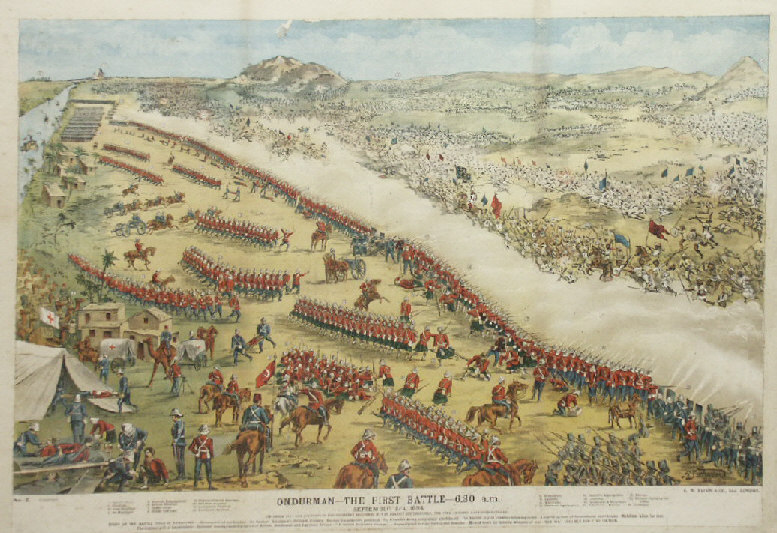
On the 2nd of September 1898 the Anglo-Egyptian Army, under Horatio Herbert Kitchener, met the Mahdist Sudanese Army (also known as the Dervishes) outside the town of Omdurman. The superior firepower of the Anglo-Egyptians devastated the Sudanese. Professor Toye refers to an estimate of 11,000 Sudanese dead and 16,000 wounded. 


The Battle of Omdurman, Sept 1898 (in actuality the British wore khaki)

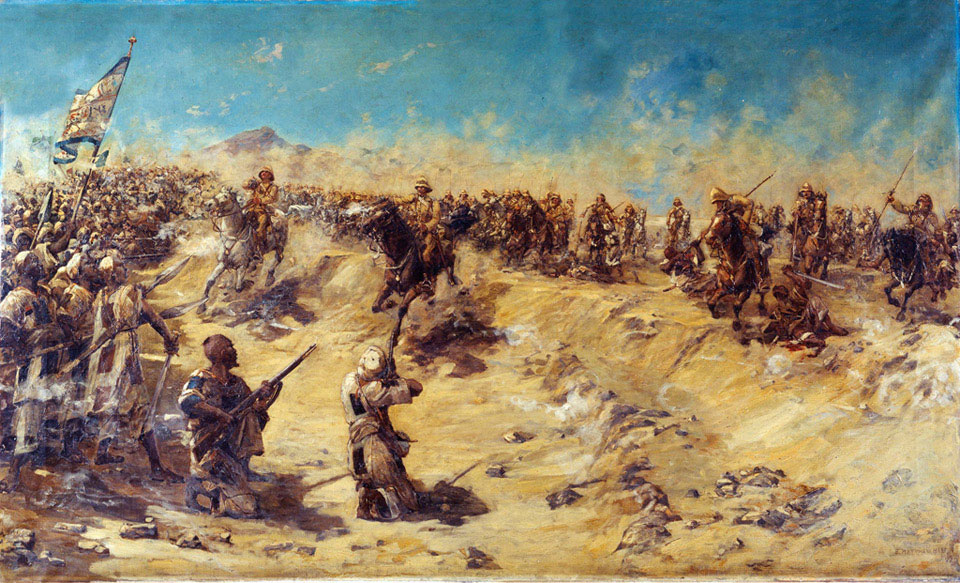
The 21st Lancers were ordered to harass the Dervishes and prevent them from retreating back to Omdurman. Churchill’s regiment came under musket fire from a party of Sudanese warriors. In his book, The River War, Churchill estimated that this party numbered no more than one hundred men strong. Colonel Roland Martin ordered the 21st Lancers to attack them and sweep them off the field of battle. 

The Charge of the 21st Lancers

What wasn’t apparent to the 21st Lancers was that a larger number of Dervish warriors – heavily outnumbering the 21st Lancers - were hiding in a dried-out watercourse out of their line of sight. The 21st Lancers charged right into them. The skirmish that followed was brief but brutal. To quote Churchill:  

The collision was prodigious. Nearly thirty Lancers, men and horses, and at least two hundred Arabs were overthrown. The shock was stunning to both sides, and for perhaps ten wonderful seconds no man heeded his enemy. Terrified horses wedged in the crowd, bruised and shaken men, sprawling in heaps, struggled, dazed and stupid, to their feet, panted, and looked about them. Several fallen Lancers had even time to re-mount. Meanwhile the impetus of the cavalry carried them on. As a rider tears through a bullfinch, the officers forced their way through the press; and as an iron rake might be drawn through a heap of shingle, so the regiment followed. They shattered the Dervish array, and, their pace reduced to a walk, scrambled out of the khor [watercourse] on the further side, leaving a score of troopers behind them, and dragging on with the charge more than a thousand Arabs. Then, and not till then, the killing began; and thereafter each man saw the world along his lance, under his guard, or through the back-sight of his pistol; and each had his own strange tale to tell.

Stubborn and unshaken infantry hardly ever meet stubborn and unshaken cavalry. Either the infantry run away and are cut down in flight, or they keep their heads and destroy nearly all the horsemen by their musketry. On this occasion two living walls had actually crashed together. The Dervishes fought manfully. They tried to hamstring the horses. They fired their rifles, pressing the muzzles into the very bodies of their opponents. They cut reins and stirrup-leathers. They flung their throwing-spears with great dexterity. They tried every device of cool, determined men practised in war and familiar with cavalry; and, besides, they swung sharp, heavy swords which bit deep. The hand-to-hand fighting on the further side of the khor lasted for perhaps one minute. Then the horses got into their stride again, the pace increased, and the Lancers drew out from among their antagonists. Within two minutes of the collision every living man was clear of the Dervish mass. All who had fallen were cut at with swords till they stopped quivering, but no artistic mutilations were attempted

The 21st Lancers suffered over a fifth of their number – 70 men out of 310 – killed or wounded. According to military historian Edward Spiers, these losses – and the losses of about 120 horses – were so heavy that they left the regiment effectively “out of action” (Spiers, "Campaigning under Kitchener", p.72)

Churchill gave a more detailed personal account in his later autobiography My Early Life and relays the circumstances in which he shot Dervishes: 

Straight before me a man threw himself on the ground. The reader must remember that I had been trained as a cavalry soldier to believe that if ever cavalry broke into a mass of infantry, the latter would be at their mercy. My first idea therefore was that the man was terrified. But simultaneously I saw the gleam of his curved sword as he drew it back for a ham-stringing cut. I had room and time enough to turn my pony out of his reach, and leaning over on the off side I fired two shots into him at about three yards. As I straightened myself in the saddle, I saw before me another figure with uplifted sword. I raised my pistol and fired. So close were we that the pistol itself actually struck him. Man and sword disappeared below and behind me. On my left, ten yards away, was an Arab horseman in a bright-coloured tunic and steel helmet, with chain-mail hangings. I fired at him. He turned aside. I pulled my horse into a walk and looked around again [emphasis added].

Churchill also wrote that he shot at a fourth man:

The other three troops of the squadron were re-forming close by. Suddenly in the midst of the troop up sprung a Dervish. How he got there I do not know. He must have leaped out of some scrub or hole. All the troopers turned upon him thrusting with their lances: but he darted to and fro causing for the moment a frantic commotion. Wounded several times, he staggered towards me raising his spear. I shot him at less than a yard. He fell on the sand, and lay there dead. How easy to kill a man!

What exactly was Churchill supposed to do? Let himself get hacked to death by swordsmen? Let himself get impaled by a spear? Complaining that Churchill killed several Sudanese warriors is completely unreasonable. Of course, he killed them. He was a soldier, they were soldiers, and they were all fighting for their lives. Had Churchill not killed them, they would have killed him. Killing is par for the course in a battle. 

Far from behaving in a disreputable manner, Churchill’s conduct was praised at the time. Douglas S. Russell notes that:

In his combat in his third war, Churchill comported himself very capably, showing his characteristic dash and indifference to danger. Trumpeter A. Norris of A Squadron later recalled: ‘Mr Churchill was in command of my troop and I must say that he was a daring and resourceful soldier… I saw him firing away for all he was worth.’ The regimental magazine of the 21st Lancers, The Vedette, referred to Churchill as a ‘very cool-headed young officer’… (Douglas S. Russell, Winston Churchill: Soldier, p.225).

Incidentally, contrary to Hirsch’s claim that this incident isn’t well known because none of the films about Churchill show it, the charge of the 21st Lancers is depicted in the 1972 film Young Winston.


This isn’t a particularly obscure film either. The BBC tends to air it every few years. 

A Victory Disgraced

The aftermath of the Battle of Omdurman proved controversial. Kitchener was criticized for allegedly abandoning the Dervish wounded and making no effort to provide them with medical assistance. Furthermore, it was claimed that Kitchener had ordered Anglo-Egyptian troops to killed wounded Dervishes on the spot. Leading the charge against Kitchener was The Westminster Gazette correspondent Ernest Bennett (Cecil, “British Correspondents”, pp.120-1). Kitchener flatly denied the accusations against him. He had his supporters. Another war correspondent (and veteran of the American Civil War on the Confederate side) called Bennet Burleigh devoted a postscript in his own book denouncing Bennett. Another defender of Kitchener was a member of the Royal Prussian General Staff, Capt. Adolf von Tiedemann, who was with Kitchener throughout the battle. 

An uninformed reader might think, on the basis of Hari’s review, that Churchill must have backed Kitchener to the hilt, and either covered up the massacre and neglect of the wounded Sudanese or justified it. This is not the case. Professor Toye says that the sight of the dead and dying Dervishes strewn across the landscape in the aftermath of the battle did affect Churchill. Contrary to Hari and Hirsch it did not cause any feelings of joy though. Churchill wrote that his sense of victory faded and was overtaken by a “mournful feeling of disgust” (quoted in Toye, Churchill's Empire, p.55). Churchill also wrote:

there was nothing dulce et decorum about the Dervish dead. Nothing of the dignity of unconquerable manhood. All was filthy corruption. Yet these were as brave men as ever walked the earth. The conviction was borne in on me that their claim beyond the grave in respect of a valiant death was as good as that which any of our countrymen could make. The thought may not be original. It may happily be untrue. It was certainly most unwelcome (quoted in Toye, Churchill's Empire, p.55)

I couldn’t find anywhere in Toye’s book where he says that Churchill “bragged” or boasted that he shot three Dervishes. I am not sure where Hari found this. Given his track record though it is quite possible that Hari just made it up out of whole cloth.

Churchill was quite proud that his own unit took prisoners alive rather than killing them outright:

I rejoice for the honour of the British cavalry when I reflect that they held their heads very high and that the regiment that suffered by far the greatest loss also took the greatest number of prisoners(quoted Douglas S. Russell, Winston Churchill: Soldier, pp.232-233).

Pretty much every writer has recorded that Churchill was appalled by the callous and brutal treatment of enemy wounded (e.g. Gilbert, Churchill: A Life, p.99; James, Churchill and Empire, p.10). In a letter to Ian Hamilton on the 16th of September 1898, Churchill wrote:

I am in great disfavour with the authorities here. Kitchener was furious with Sir E. Wood for sending me out and expressed himself freely. My remarks on the treatment of the wounded – again, disgraceful – were repeated to him and generally things have been a little unpleasant. He is a great general, but he has yet to be accused of being a gentleman (quoted Russell, Winston Churchill: Soldier, p.233).

After the war, in a letter to his mother, he referred to the victory at Omdurman as being “disgraced by the inhuman slaughter of the wounded” (quoted in James, Churchill and Empire, p.10)

Professor Toye doesn’t contradict any of this. In fact, he even says explicitly that in the aftermath of the battle Churchill was upset by the “maltreatment of the wounded and the desecration of the Mahdi’s tomb” (quoted in Toye, Churchill's Empire, p.56). It frankly boggles the mind that Hari missed this part of Toye's book. 

The only hint of criticism Toye levels at Churchill is that he thinks that after the war Churchill pulled his punches when it came to criticizing Kitchener. Maybe so, although I personally was not persuaded by all of Toye’s evidence. To take one example, the criticisms of Kitchener in The River War are described as being “modest” by Toye. Perhaps they seem modest to Professor Toye but they didn’t seem so to all reviewers at the time. Professor Toye even references one review in The Star which was subtitled “Churchill’s Severe Criticism of Lord Kitchener” (Toye, Churchill's Empire, p.331; emphasis added).

Conclusion

Hari and Hirsch’s tactics are a classic example of selectivity in fact being mixed with a downright untruth. They state that Churchill killed three Sudanese people. This is correct, he did. But they leave out that this was in the midst of a brutal skirmish and that the people he shot were armed warriors who would have tried to kill him if he didn’t shoot them first. There is nothing unethical or problematic in what Churchill did at the Battle of Omdurman. 

The suggestion that Churchill enjoyed killing those warriors is misleading. Hari’s claim that he “bragged” about it afterward doesn’t appear in the book Hari reviewed. That same book records Churchill as saying he had a feeling of “disgust” at the sight of dead and dying Dervishes. It is well known that Winston was appalled by the mistreatment of wounded Dervishes, referring to it as a “disgrace” in his correspondence.

Hari and Hirsch present Churchill at Omdurman as being at his imperialist worst. In truth, Churchill’s behaviour there was him at his humanitarian best.  

 Bibliography

Cecil, Hugh, "British Correspondents and the Sudan Campaign of 1896-98" in Edward M. Spiers (ed.), Sudan: The Conquest Reappraised (Frank Cass, 1998), pp.102-127

Churchill, Winston, The River War: An Account of the Reconquest of the Sudan (1902 Edition)

Churchill, Winston, My Early Life: A Roving Commission (Thornton Butterworth, 1931)

Gilbert, Martin, Churchill: A Life (Pimlico, 2000)

Hyam, Ronald, "Winston Churchill's First Years in Ministerial Office, 1905-1911" in Ronald Hyam, Understanding the British Empire (Cambridge University Press, 2010), pp.299-318

James, Lawrence, Churchill and Empire: Portrait of an Imperialist (Weidenfeld & Nicholson, 2013)

Roberts, Andrew, Churchill: Walking with Destiny (Penguin, 2019)

Russell, Douglas S., Winston Churchill: Soldier: The Military Life of a Gentleman at War (Conway, 2005)

Spiers, Edward M., "Campaigning Under Kitchener" in Edward M. Spiers (ed.), Sudan: The Conquest Reappraised (Frank Cass, 1998), pp.54-81

Toye, Richard, Churchill's Empire: The World That Made Him and the World He Made (MacMillan, 2010)

Fallacies of a Fundamentalist

Occasionally he stumbled over the truth, but hastily picked himself up and hurried on as if nothing had happened – Winston Churchill, 1936 (...