Showing posts with label Left-wing myths. Show all posts

Tuesday, March 15, 2022

Beer and Sandwiches

 A common criticism of Churchill, particularly one made by left-wingers, is that he was hostile to trade unions. In a recently published essay in Jacobin, Lenin fanboi Tariq Ali refers to Churchill as a “foe of trade unions”. This is supposedly demonstrated by his opposition to strike action, which he had crushed using military force. Historian Priya Satia mentions Churchill as “violently” putting down strikes. The BBC listed Churchill’s treatment of striking workers in a list of controversies concerning Churchill. As is par for the course, geniuses on Twitter spread this viewpoint with the helpful addition of entirely made-up quotes.

The truth is, though, that Churchill supported trade unions. He was their friend, not their foe. He supported the right to strike, although he didn’t support every particular strike that took place while in office.

Tonypandy. Villain?

By far the most notorious strike Churchill dealt with took place in Tonypandy, in Wales, in 1910. The incident is so infamous that Churchill supposedly earned the lasting enmity of the Welsh mining communities. In 2019 John McDonnell, then the Shadow Chancellor, replied “Tonypandy; villain” when he was asked if Churchill was a hero or villain. The truth of the Tonypandy incident is rather different to the leftwing mythology. The late Paul Addison, in his book Churchill on the Home Front, 1900-1955, discussed it in some detail. The account below is based largely on this book (except where otherwise cited). 

In 1910 coal miners in the Rhondda valley in Wales went on strike. There were fights between the police and miners at the Glamorgan Colliery near the town of Tonypandy. The Chief Constable of Glamorgan was sufficiently concerned about the situation that he called for troops to be sent to his jurisdiction to support the police. He was perfectly within his powers to make such a request. However, after an appeal by the President of the South Wales Mines Federation, Churchill, in his capacity as Home Secretary, cancelled the dispatch of troops to Glamorgan. Churchill had police officers from elsewhere sent to Wales to support the police there. Churchill also sent a personal message to the strikers that was read to them at a mass meeting:

Their best friends here are greatly distressed at the trouble which has broken out and will do their best to help them get fair treatment. Askwith [Arbitrator at the Board of Trade], wishes to see Mr. Watts Morgan with six or eight local representatives at Board of Trade, 2 o’clock tomorrow. But rioting must cease at once so that the enquiry shall not be prejudicial and to prevent the credit of the Rhondda Valley being impaired.

However, the violence escalated and that evening riots rampaged throughout Tonypandy, damaging and trashing over 60 shops and businesses. One man was killed in the riot. Churchill rescinded his ban on the dispatch of troops. 

This supposedly brutal military occupation resulted in not a single casualty, let alone any fatalities. General Macready set out the policy vis-à-vis troops in a memorandum:

In accordance with the verbal instructions of the Home Secretary, the general line of policy pursued throughout the strike was that in no case should soldiers come in direct contact with rioters unless and until action had been taken by the police. In the event of the police being overpowered, or not being in sufficient strength to protect a large and intersected area, the military force would come into play, but even then each body of military should be accompanied by at any rate a small body of police to emphasize the fact that the armed forces act merely as the support of the civil power and not as direct agents (quoted in Geary, Policing Industrial Disputes, p.35)

Roger Geary sums up Churchill’s policy as “delaying the arrival of troops, sending police reinforcements, obtaining an independent assessment of the situation and finally, if absolutely necessary, authorising the military to move into the disturbed area with instructions to avoid contact with the miners if at all possible” (Geary, Policing Industrial Disputes, p.35)

So far from being an example of his hostility towards organised labour, Churchill acted with restraint, sending troops only when he felt he had to and only to support civil authorities (and not for the purposes of suppressing the strike). Historian Roland V. Sires defended Churchill: 

Churchill could hardly have escaped criticism in the South Wales coal strike. If he had precipitately sent troops to intervene he would have been charged with being an enemy of labor; if he had withheld police or military forces he would have been criticized for indifference to public peace and the protection of property. He steered a middle course between intimidation and laxity and caused each side to be instructed as to its rights and duties. His actions may have avoided a deadly clash between military forces and the disaffected miners. He consistently held to his standards of government action in a violent industrial dispute - the police should protect life, property, and the public peace, and the military should be used only when the police could not cope with the situation. He cannot properly be blamed for violent acts by either strikers or policemen (Sires, ‘Labor Unrest in England’, p.260).

As for the claim that Churchill earned the enmity of Welsh miners forever, Langworth quotes W.H. Mainwaring, a militant striker at the time:

We never thought that Winston Churchill had exceeded his natural responsibility as Home Secretary. The military that came into the area did not commit one single act that allows the slightest resentment by the strikers. On the contrary, we regarded the military as having come in the form of friends to modify the otherwise ruthless attitude of the police forces (Quoted in Langworth, Myth and Reality, p.42). 

Afterwards, Churchill moved to improve the working conditions of the miners. As Paul Addison says:

Churchill’s response was to bring forward new legislation to improve safety regulations and reduce the number of fatal accidents. The proposals contained in his Coal Mines Bill derived mainly from a report of a Royal Commission, with some additions by the Mines Department of the Home Office. Churchill supplied the political drive and, no less important, obtained the necessary finance…

The Great Unrest

Tonypandy was far from the only strike Churchill had to deal with as Home Secretary. The following year was one of tremendous industrial strife - The Great Unrest. Nine percent of the industrial population of Britain was involved in strikes of one kind or another in 1911, compared with an average of 2.9 percent between 1902 and 1911 (Sires, ‘Labor Unrest in England’, p.246). This period is almost completely forgotten in the popular memory of Churchill, though ironically it was a far more serious affair than occurred at Tonypandy. Paul Addison wrote that by his response to the strikes, Churchill “fatally compromised” his reputation as a radical reformer. However, Addison added a qualifier:

Churchill was deeply disturbed by militant industrial unrest and reacted strongly against it. He became, to this extent, anti-labour. But like most parliamentary politicians he was careful to distinguish between the ‘militants’ and the ‘moderates’ of the labour movement. It would be wrong to suppose that he turned against the working-class, the Labour party, or the trade unions, as a whole. But he did begin the fear the influence of subversive and revolutionary elements (emphasis added).

Churchill had three concerns during the unrest of 1911. Firstly, was the economic and social impact of the strikes. In the summer of 1911, a national seamen’s strike began in the ports, which spread to the dockers. In August 1911 the railway workers also went on strike. These effectively paralysed the British transport system. According to Paul Addison:

The Government was suddenly faced by the possibility of an almost complete standstill in the import and distribution of food supplies. The local authorities, prompted by the port and shipping employers, appealed to the Government to provide troops or extra police for the protection of strike-breaking workers.

In London, food shortages were reported as early as the 10th of August as supplies of fresh food dwindled. On the 16th of August Liverpool based cold-storage companies warned that without deliveries of coal then £3 million worth of meat would rot. The Mayor of Liverpool warned that there would be shortages of flour and bread due to strikes and that food “must be getting very scarce in the poorer districts”. On the 16th of August, the mayor of Sheffield reported that food was getting short in that town as well. On the 17th of August Liverpool’s Health department reported their concern about the health impact of the strike as “the men employed on the sanitary service… have struck… therefore there are no water carts and no clearance of dust etc from the streets, and no collection of refuse from houses”. That same day the Lt-Governor of the Isle of Man reported that the island’s supply of sugar and butter had run out, fresh meat would run out in a day, stocks of tinned meat and fish would last only week and coal supplies would only last a few days. The next day authorities in Hull complained that food supplies were being “menaced”, and leading wholesale suppliers of pharmaceuticals warned that orders of medicines from doctors and hospitals could not be met. On the 22nd of August, the Wholesale Provision Association in Manchester reported that “large quantities” of provisions were “badly wanted”. In Stoke-on-Trent, the food situation was “one of gravest importance” (Davies, “Crisis?”, p.110-113).

Churchill’s second concern was the rioting that attended the strikes. Major rioting took place in numerous cities and towns. Many perceived matters as going beyond a mere industrial dispute. As Roger Geary writes:

There seems little doubt that this reversion to a more military response occurred because of a growing sense of extreme unease in establishment circles. For example, the King thought that the situation was ‘more like a revolution than a strike’. Similarly, the Mayor of Liverpool told Lord Derby that ‘it is no ordinary strike riot’ and a Hull councillor remarked that the situation was worse than that prevailing during the Paris Commune (Geary, Policing Industrial Disputes, p.37).

Destruction of private property, intimidation of non-striking labourers and of their families and harassment of businesses to prevent them from serving non-striking workers were regrettably unlawful tactics used by some of the strikers throughout the summer (Davies, "Crisis?", p.108). Requests from local authorities for troops to support civil authorities poured into the Home Office. In June Churchill authorized the dispatch of additional police to Hull, and in July in response to a request for soldiers from the Lord Mayor of Manchester he sent the Royal Scots Greys to Salford. In August rioting “on a scale approaching that of a local civil war” (according to Paul Addison) broke out in Liverpool. Again, at the request of the local authorities, Churchill assented to the dispatch of infantry and cavalry troops to the town, as well as a Royal Navy cruiser. In total, 58,000 troops were mobilised and sent to various trouble spots while four warships and eight other vessels were sent to protect various ports (in addition to the one sent to Liverpool, ships were sent to London, Hull and Barrow) (Davies, “Crisis?”, pp.113-114).

The third concern of Churchill’s was the impact on Britain’s strategic position. This unrest took place against the backdrop of the Agadir Crisis when Britain and France came close to war with Germany. According to Paul Addison, Churchill received allegations that labour leaders were being bankrolled by a German agent named Bebel. Addison quotes the diary of Sir Almeric Fitzroy, the clerk of the Privy Council, as recording that “Winston Churchill is said to be convinced that the whole trouble is fomented by German gold, and claims to have proof of it, which others regard as midsummer madness”. 

Churchill initially tried to chart a moderate course. As Paul Addison put it, “in the policing of the dispute Churchill strove to ensure the impartial enforcement of the law as between workman and employer”. What this meant was that owners had a right to use voluntary labour while strikers had the right to peacefully picket. In early August, Churchill allowed mediation to take place between the London dockers and the chief industrial conciliator at the board of trade. The dispute was resolved peacefully, and socialist leader Ben Tillett credited Churchill thus:

He refused to listen to the clamour of class hatred, he saved the country from a national transport stoppage becoming a riot and incipient revolution.

Unfortunately, riots were not always peacefully brought to an end. On the 15th of August a convoy of prison vans in Liverpool was attacked by an angry crowd. Soldiers opened fire and two people were killed (Davies, “Crisis?”, p.115). 

The announcement of a national railway strike a few days later caused a change in policy. The government adopted a more belligerent stance. Churchill decided the situation was so serious that troops were to be sent to trouble spots by the Home Office, rather than simply sent upon request of local authorities. According to Roger Geary, this meant that some places were provided military support despite not asking for it (Geary, Policing Industrial Disputes, p.37). The purpose of sending these troops was not to attack or kill strikers, but to, as Paul Addison puts it, “the protection of the rail network from sabotage [and] to enable the companies to continue as best they could with non-union labour”.

Thankfully, incidents that resulted in deaths were extremely rare despite the serious situation. The 58,000 troops mobilised only killed four civilians during the whole summer. In addition to the aforementioned Liverpool shooting, on the 19th of August in Llanelli a train carrying strike-breaker workers was halted by strikers, who then proceeded to pelt the armed troops with stones. According to the Chief Constable of Carmarthenshire:

Troops attacked on both sides by crowd on embankments hurling stones and other missiles. One soldier carried away wounded in head and others struck. Riot Act read. Major Stuart mounted embankment and endeavored to pacify crowd. Stone throwing continued, crowd yelling at troops. Shots fired as warning, no effect, attitude of crowd threatening and determined. Other shots fired, two men killed, one wounded, crowd fled (quoted in Geary, Policing Industrial Disputes, p.45).

Naturally, the exact course of events was heavily disputed, with some accusing the troops of committing murder. Nonetheless, a jury returned a verdict of “justifiable homicide” (Geary, Policing Industrial Disputes, p.45). In the aftermath of the shooting, rioters proved a greater menace to their own safety than the soldiers did – four were killed in an explosion after they set fire to a train containing explosives

It is likely that the police and army did, at times, act with unjustifiable brutality. While Churchill categorically did not order troops and police to rough-up rioters, the hardening stance as the strikes continued may have, according to Roger Geary, conditioned the police to act more strongly than they might otherwise have done so. Geary says:

There is, for example, no evidence of a concerted policy of repression being formulated at the Home Office, but a preference for ‘vigorous’ police action is unmistakable (Geary, Policing Industrial Disputes, p.44).

In fairness to the police, Geary notes that police tactics for riot control were not as sophisticated as today. The standard tactic, the baton charge, was unavoidably indiscriminate. To quote Geary:

 there was a strategic commitment to impartial policing [but] the relatively undeveloped state of control tactics militated against its implementation (Geary, Policing Industrial Disputes, p. 43; emphasis added).

In summary, in 1911 Churchill was faced with an unprecedented series of strikes. These strikes threatened to cause food shortages, public health catastrophes, and cripple the country on the eve of a war. Widespread rioting forced him to agree to requisitions of troops by local authorities to support law and order. Churchill, and others in the government, became more belligerent and hostile to the strike the longer it lasted, and he changed the rules to allow the Home Office to immediately send the military to support law and order without a local invitation. However, the troops were not sent by Churchill to massacre or brutalise strikers, as evidenced by the fact that 58,000 troops only killed four people during the entire summer. It was these particular strikes Churchill was hostile to, not the working class or trade unions as a whole. As Churchill put it in a handwritten letter to a Liberal Party organizer in Manchester:

The progress of a democratic country is bound up with the maintenance of order. The working classes would be almost the only sufferers from an outbreak of riot & a general strike if it could be effective would fall upon them & their families with its fullest severity. At the same time the wages now paid are too low and the rise in the cost of living (due mainly to the increased gold supply) makes it absolutely necessary that they should be raised. I have never heard of the British people complaining (as they now do) without a good & just cause. I believe the Government is now strong enough to secure an improvement in social conditions without failing in its primary duties.

Socialism, Individualism and Trade Unionism

When examining Churchill’s view or impact there is a tendency by both detractors and hagiographers to take a particular moment/speech/letter and identify that as showing who Churchill really was. For example, detractors often take a distorted picture of the Tonypandy incident (or the lesser-known strikes in 1911) and say that this shows Churchill’s true colours – a class warrior who was opposed to working-class interests and trade unions. However, these specific incidents lasted only a few weeks and Churchill’s career in politics lasted over half a century. To understand Churchill’s actual position on trade unions it is necessary to examine the whole of his career.

In 1899, during his first election campaign, Churchill famously declared support for social reforms and improving the condition of the working class:

I regard the improvement of the condition of the British people as the main aim of modern government… I shall therefore promote to the best of my ability all legislation which, without throwing the country into confusion and disturbing the present concord, and without impairing that tremendous energy of production on which the wealth of the nation and the good of the people depend, may yet raise the standard of happiness and comfort in English homes (quoted in Wrigley, ‘Trade Unions’, pp.47-48).

As Christ Wrigley puts it, Churchill’s view of labour can be understood by the phrase noblesse oblige. What this entailed was an expectation that the ruling classes should use their position to behave honourably to the ‘lower orders’ (Wrigley, “Trade Unions”, p.49). 

It shouldn’t be surprising that Churchill thought along these lines. Anyone familiar with British history will know that the Conservative party under Disraeli had already passed quite a bit of social reform legislation. Churchill’s father, Lord Randolph Churchill, developed a conception of ‘Tory Democracy’ (today called One Nation Conservatism) that supported social reform. So, Churchill’s support for “the improvement of the condition” of the working class wasn’t exactly a radical departure from Conservative thinking.

Churchill also saw himself as an individualist. In October 1906 he said:

The existing organization of society is driven by one mainspring – competitive selection. It may be a very imperfect organization of society, but it is all we have got between us and barbarism… and great and numerous as are the evils of the existing condition of society in this country, the advantages and achievements of the social system are greater still. Moreover that social system is one which offers an almost indefinite capacity for improvement… I do not want to see impaired the vigour of competition, but we can do much to mitigate the consequences of failure. We want to draw a line below which we will not allow people to live and labour, yet above which they may compete with all the strengths of their manhood (quoted in Wrigley, “Trade Unions”, p.50).

Crucially, Churchill did not see trade unions as contradicting the principle of individualism. In fact, he supported them as they strengthened the hand of workers in industrial disputes. In October 1906 Churchill said:

[I]t is the trade unions that more than any other organization must be considered the responsible and deputed representatives of Labour. They are the most highly organised part of labour; they are the most responsible part; they are from day to day in contact reality… The fortunes of the trade unions are interwoven with the industries they serve. The more highly organised trade unions are, the more clearly they recognize their responsibilities; the larger the membership, the greater their knowledge, the wider their outlook (quoted in Wrigley, “Trade Unions”, p.52). 

Churchill was no socialist. But he was a ‘Tory Democrat’ initially and later a Liberal. He contrasted socialism and liberalism and summarized the differences between the two ideologies thus:

Socialism seeks to pull down wealth; Liberalism seeks to raise up poverty. Socialism would destroy private interests; Liberalism would preserve private interests in the only way they can be safely and justly preserved, by reconciling them with public right. Socialism would kill enterprise; Liberalism would rescue enterprise from the trammels of privilege and preference (quoted in Pelling, “Labour Movement”, p.115).

He did not regard trade unionism as socialistic per se. In 1908 he declared:

Trade unions are not socialistic. They are the antithesis of socialism. They are undoubtedly individualistic organisations, more in character of the old Guilds, and much more in the culture of the individual, than they are in that of the smooth and bloodless uniformity of the masses (quoted in Wrigley, “Trade Unions”, p.52).

The same year he also said:

While I believe in the advantages of a competitive system under which man is pitted against man, I do not believe in allowing men to be pitted against each other ruthlessly until the last drop of energy is extracted, and there the trade unions come in as safeguards and checks (emphasis added; quoted in Wrigley, “Trade Unions”, p.53).

In May 1911 Churchill said the following:

I consider that every workman is well advised to join a trade union (quoted in Wrigley, “Trade Unions”, p.55).

In 1928 Churchill further demonstrated his support for trade unionism by joining one himself. Churchill wasn’t motivated by self-interest; he didn’t require help in a dispute with his employer. The local secretary of the Amalgamated Union of Building Trade Workers invited him to join because of his brick-laying hobby. Churchill told the secretary that he would be “very pleased to join the union”, sent off the membership dues and was admitted as a member. The Union’s executive council ruled him ineligible, but not before he acquired a membership certificate (Pelling, “Labour Movement”, p.121). 

He was willing to give practical support to trade unions too. In 1901 the House of Lords (then the highest appellate court in the United Kingdom) decided in Taff Vale Railway co v Amalgamated Society of Railway Servants that trade unions were tortiously liable for loss of profits due to strike action. This represented a major setback for the union movement, and Churchill voted in favour of a resolution to nullify the Taff Vale decision (Pelling, “Labour Movement”, p.114). Churchill was one of the few members of the Cabinet who voted for the Trade Disputes Bill - which would negate Taff Vale – on its second hearing (Farr, Reginald McKenna, p.87).

After the Second World War Churchill, according to Chris Wrigley, “continued to take a positive view of the trade unions” (Wrigley, ‘Trade Unions’, p.65). During the 1947 Conservative Party conference he said: 

The trade unions are a long-established and essential part of our national life… we take our stand by these pillars of our British Society as it has gradually developed and evolved itself, of the right of individual labouring men to adjust their wages and conditions by collective bargaining, including the right to strike (quoted in Wrigley, ‘Trade Unions’, p.65). 

He repeated the theme of the trade union as being an essential British institution in the 1950 conference and added:

I have urged that every Tory craftsman or wage-earner should of his own free-will be a trade unionist, but I also think he should attend the meetings of his trade union and stand up for his ideas instead of letting only socialists and communists get control of what Is after all an essentially British institution (Quoted in Wrigley, ‘Trade Unions’, p.65).

Conclusion

Contrary to far-left mythology, Churchill actually supported trade unions. Throughout his career he made statements expressing the view that they were a ‘British’ institution. For him, socialist infiltration of unions was something to be regretted, but it didn’t make him hostile to unions per se. His support wasn’t just empty words, as demonstrated by his support for legislation overriding the Taff Vale decision. Despite claims that Churchill repressed strikers, he was in fact on the record as supporting the right to strike. In 1904 he said:

It is most important for the British working classes that they should be able if necessary to strike – although nobody likes strikes – in order to put pressure upon the employers for a greater share of the wealth of the world or for the removal of hard and onerous conditions but in the socialist state no strike would be tolerated (quoted in Wrigley, ‘Trade Unions’, p.52)

Historian Henry Pelling put it best:

In the course of his peregrinations through the British party system [Churchill] retained a number of clear principles for his political conduct. One was opposition to socialism, which he regarded as an enemy of good government…. But another principle was sympathy for working people and for their representative leaders, that is to say, trade unionists, whom he regarded as an estate of the realm quite as much as any other (Pelling, ‘Labour Movement’, p.128).

Bibliography

Addison, Paul, Churchill on the Home Front, 1900 – 1955 (Kindle edition, 2013)

Davies, Sam, “’Crisis? What Crisis?’: The National Rail Strike of 1911 and the State Response”, Historical Studies in Industrial Relations, Vol 33, No. 12, pp.97 -126

Farr, Martin, Reginald McKenna: Financier Among Statesmen, 1863 – 1916  (Routledge, 2008)

Geary, Roger, Policing Industrial Disputes: 1893 to 1985 (Cambridge University Press 1985)

Langworth, Richard M., Winston Churchill, Myth and Reality: What He Actually Did and Said (McFarland & Co, 2017)

Pelling, Henry, “Churchill and the Labour Movement”, in Robert Blake and Wm. Roger Louis (eds), Churchill: A Major New Assessment of His Life in Peace and War (Clarendon Press, 1996), pp.113-128

Sires, Roland V., “Labor Unrest in England, 1910 – 1914”, The Journal of Economic History, Vol. 15, No.3 (September 1955), pp.246-266

Wrigley, Chris, “Churchill and the Trade Unions”, in David Cannadine and Roland Quinault (eds.), Winston Churchill in the Twenty-First Century (Cambridge University Press, 2004), pp.47–67

Friday, May 21, 2021

Greek Tragedy

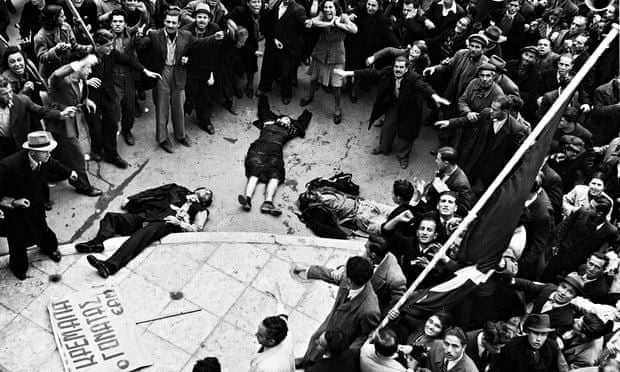
 In 2014 The Observer published an article headlined “Athens 1944: Britain’s dirty secret”. The authors alleged that in December 1944 British troops shot and killed unarmed civilian demonstrators on the streets of Athens, Greece. The subtitle of the article states:

When 28 civilians were killed in Athens, it wasn’t the Nazis who were to blame, it was the British. Ed Vulliamy and Helena Smith reveal how Churchill’s shameful decision to turn on the partisans who had fought on our side in the war sowed the seeds for the rise of the far right in Greece today

And the caption under one of the photographs says:

A day that changed history: the bodies of unarmed protestors shot by the police and the British army in Athens

A few paragraphs into their article the authors write:

This was the day [3rd of December 1944], those 70 years ago this week, when the British army, still at war with Germany, opened fire upon – and gave locals who had collaborated with the Nazis the guns to fire upon – a civilian crowd demonstrating in support of the partisans with whom Britain had been allied for three years.

Thus, was born another element of the Churchillian Black Legend – Winston Churchill's massacre of innocent Greek civilians. 

Contrary to what The Observer says, these people were not killed by British soldiers.

The article appeared, on the surface, to be credible. It was written by two distinguished journalists: Ed Vulliamy, a notable war reporter, and Helena Smith, the Guardian’s correspondent for Greece, Turkey, and Cyprus.  They cite several experts on Greek history and also interviewed eyewitnesses of the event. Therefore, it isn’t surprising that their article has been very influential. Indian politician and writer Shashi Tharoor wrote in the Washington Post that:

This week’s Oscar rewards yet another hagiography of this odious man [Churchill]. To the Iraqis whom Churchill advocated gassing, the Greek protesters on the streets of Athens who were mowed down on Churchill’s orders in 1944, sundry Pashtuns and Irish, as well as to Indians like myself, it will always be a mystery why a few bombastic speeches have been enough to wash the bloodstains off Churchill’s racist hands (emphasis added).

 The reference to “Greek protestors” links to the article by Vulliamy and Smith. 

The Indian news channel WION (World is One News) summarised the events thus:

In the year 1949 [sic], Churchill ordered the British army to fire on the anti-Nazi protestors in Greece...

If you google “Churchill Athens”, Vulliamy and Smith’s essay is the top suggestion out of 4,280,000 results. 

There is one problem with the allegation – it is completely untrue.

Fake News

Almost four months after that Vulliamy and Smith’s article was published, Stephen Pritchard was compelled to write a follow-up. This later article proves that the lurid account of British troops gunning down protestors was false. According to Pritchard, after Vulliamy and Smith’s article was published:

Seven Greek historians protested. They said the British had not fired on the crowd, but that Greek police certainly had, and that to present the December confrontation as one fought between the British alongside supporters of the Nazis against the partisans was “a gross misrepresentation” (emphasis added).

This isn’t a controversial point. No one before Vulliamy and Smith had ever claimed that the British Army shot at a civilian crowd on the 3rd of December 1944. Greek police certainly did, but there was no British involvement in that massacre. It frankly boggles the mind that this accusation passed even the most basic fact-check review. 

What followed after this protest by historians is quite revealing as to Weltanschauung of The Observer:

The following week, I ran a clarification, noting the protest by the seven and pointing out that Greek police were also likely to be among those who shot the 28 protesters. I recognise now that it was plainly inadequate in addressing concerns about the article (emphasis added).

So, after being told that they were flat out wrong about British troops killing Greek protestors, The Observer doubled down, merely suggesting that it was “likely” that Greek police were also involved in the shootings. This crosses the line from being reckless with the facts to being deliberately dishonest. The Observer was so keen to portray British troops in a negative light that they just assumed their involvement in the shooting. The slander was allowed to remain in the article despite numerous experts correcting the paper.

The blame for this misinformation shouldn’t fall on the elderly eyewitnesses quoted by Vulliamy and Smith. There were understandable reasons why they misremembered who was responsible for the shooting.

He [historian André Gerolymatos] wrote: “Did the British open fire on the demonstrators on 3 December 1944? The answer is no, but that reality is filtered through perceptions clouded by a day filled with violence and considerable confusion.

“The British did make an effort to peacefully disperse part of the crowd. One explanation is that some protesters easily mistook the use of tracer shells by British armoured units, fired over the heads of the demonstrators, as being directed at them. Another issue that further complicated matters was that the Greek soldiers wore British battledress, as did the Greek gendarmerie. Furthermore, there were American and British soldiers on the roof of the Grand Bretagne Hotel, observing the spectacle. For those on the ground it could have appeared that the gunfire from the police could have been mistaken as originating from the soldiers on the roof of the hotel. Although the police wore grey, they were in concealed positions on the balcony, roof, windows, and behind a wall in front of the police headquarters, making it difficult for the demonstrators to identify whether they were police or soldiers.”

The responsibility for the error lies with Vulliamy and Smith, who apparently did not bother to check this claim to see if it was correct. The Observer is at fault as well. They did not fact-check the article before publication, and they kept it online without removing the allegations. Unless a reader spots the link to Pritchard's article (which they euphemistically call a “column by the readers’ editor”) they will have a completely wrongheaded view of the events of the 3rd of December 1944. As this “readers’ editor” column has been shared a mere 59 times while the original essay has been shared 31,073 times, I suspect that the overwhelming majority of readers have been misled by the article. 

The Observer added a correction at the bottom of Vulliamy and Smith's article, but even that is misleading. It implies that it was possible that Greek police also fired on the protestors along with British troops, instead of saying that no British troops were involved:

A group of Greek historians writes concerning this article. It was reported that British troops opened fire on the Greek demonstrators from the Grande Bretagne hotel in Athens on December 3 1944. The hotel was British military headquarters, but the fire from it could also have come from Greek police.

What Actually Happened in Athens

On the morning of the 3rd of December 1944, a large demonstration took place in Athens. This demonstration was mainly left-wing, consisting of ‘communists, socialists, republicans, and antimonarchists’. According to the late André Gerolymatos, a Professor of Hellenic Studies at Simon Fraser University, some people were coerced into attending. The National Liberation Front (EAM) had previously announced that anyone who stayed away would be regarded as an “enemy of the people and dealt with accordingly (Gerolymatos, International Civil War, pp.100-101).

Greek police had cordoned the entrances to the city centre but a number of protestors broke through and advanced to the police station located near the Grande Bretagne Hotel. This was the headquarters of the Allies, i.e., the British. Gerolymatos actually is fairly understanding of the police and makes it clear that this incident wasn’t just an example of far-right Nazi collaborators butchering innocent left-wing protestors:

The policemen had every reason to fear for their lives: as they had served under the jurisdiction of the occupation authorities, the majority of Athenians had, rightly or wrongly, labeled them collaborators. Although many Greek police officials had covertly assisted the resistance and the allies, not enough time had passed since liberation to permit a clear distinction between absolute traitor and patriot. Indeed, some had had to wear the mask of the former in order to assist the latter.

Making matters worse, the Greek government failed to purge the security establishments and civil service of collaborators, whose continued presence now tainted every state official. The government had argued that time was required to conduct a meticulous and judicious purge, but such reasoning was lost on the crowds advancing toward the center of the city in the morning of 3 December 1944. To the half-starved population of Greece, symbols truly mattered, and the gray uniforms of the police invoked the fear and agony of the occupation

The handful of policemen positioned a few yards beyond their station were aware of this reality, and for the previous several hours they had witnessed dozens of wounded fellow officers being carried off on stretchers into the station following clashes with groups of demonstrators. As the crowd got closer and closer, the policemen’s fears turned to panic, and some began to replace their blank rounds with live ammunition.

When the crowd advanced to less than one hundred yards from the police cordon, suddenly a man in military uniform ran out of the station and shouted, “Shoot the bastards!” He then dropped to one knee and began firing his gun. A few seconds later the panic-stricken policemen followed suit.

They did not fire in unison like a disciplined unit, but discharged their weapons sporadically. Some of the officers hesitated for a few seconds; others had remained transfixed by the spectacle before them, but one after another they began to return fire. The first ranks of the crowd fell forward; the fortunate ones found protection behind trees or nearby walls, but most simply lay flat on the ground.

The shooting continued for approximately half an hour, and when it was over twenty-two of the demonstrators remained still, twelve of them dead (Gerolymatos, International Civil War, pp.104-105).

Gerolymatos is one of the experts cited by Vulliamy and Smith, and he is unequivocal that it was Greek policemen who shot demonstrators on the 3rd of December, not British soldiers. 

Mark Mazower, Professor of History at Columbia University and another expert cited by Vulliamy and Smith, also wrote that it was Greek police, not the British Army, who fired on protestors:

Shortly before 11 a.m., as thousands of EAM demonstrators entered Constitution Square, several policemen panicked and fired directly into the crowd from the police station which stood at one corner of the square. People fled, but it was discovered later that at least ten had been killed and over fifty injured. The initial reaction of the British 23rd Armoured Brigade, whose men moved in and cleared the square, was that the Greek police had lost their nerve: they had 'dealt rather wildly with the demonstration' and had 'fired unnecessarily' (Mazower, Inside Hitler’s Greece, p.352).

The shooting outraged left-wingers in Athens. Gerolymatos notes:

By noon, a second wave of demonstrators broke through the police cordons and was soon joined by thousands more, until the square was jammed with almost 60,000 people.11 The police retreated to their station and locked themselves inside. Over the next thirty minutes, the remaining police barricades disintegrated as most of the officers discreetly left the scene and sought refuge in nearby private homes or managed to reach the safety of the police headquarters. A few police stragglers near the square, however, were not as fortunate. They were seized by dozens of hands, punched, kicked. and spat upon. Their protestations of innocence were drowned out by a torrent of verbal abuse. The lucky ones were dragged off to the nearest lamppost and lynched; some, however, could not be pried away from the clutches of the mob, which, intoxicated by raw animal savagery, tore the men literally from limb to limb (Gerolymatos, International Civil War, p.105)

You know things are bad when being lynched makes you one of the lucky ones!

The next day shooting took place throughout the city between ELAS – EAM’s Paramilitary wing - and the police, and between ELAS and their political opponents.  By mid-afternoon ELAS had captured most of the police stations in Athens. Usually, police officers who surrendered were summarily executed by ELAS insurgents, either by being shot or hanged. Gerolymatos mentions one particularly gruesome incident:

In Piraeus, a British unit attempted to interpose itself between a police station and ELAS, but faced overwhelming opposition. After a tense verbal exchange, the guerrillas dragged out several of their prisoners and in front of the British soldiers proceeded to gouge out the eyes of these hapless prisoners. The British soldiers gawked, transfixed by the horror unfolding before them and disgusted by their impotency to interfere. The screams of the policemen reverberated along the empty streets, and were quickly reduced to low guttural moans, but the ordeal was far from over. For a few minutes, the ELAS executioners just grinned while savoring the spectacle of torment and the vulnerability of the British. Then, they took out butcher’s cleavers and began to hack off the forearms of the blind policemen and continued slashing until the bodies resembled heaps of human pulp. The agony, for victims and spectators, ended when the policemen were put out of their misery by bullets to their brains. The tormentors exploited such sadistic brutality on several levels—by exercising of their total superiority over their victims, and by forcing the British to observe the atrocity they made them de facto participants (Gerolymatos, International Civil War, p.108).

Churchill received updates on the situation in Athens throughout the 4th of December. That night he telegraphed the commander of British forces in Greece, Lt Gen Ronald Scobie: 

Do not hesitate to fire at any armed male in Athens who assails the British authority or Greek authority with which we are working….Do not hesitate to act as if you were in a conquered city where a local rebellion is in progress….It would be a great thing for you to succeed in this without bloodshed if possible, but also with bloodshed if necessary (quoted in Gilbert, Churchill, p.807; emphasis added).

Churchill was not in favour of shooting at civilian protesters. He was ordering the British Army to put down a communist insurgency. The telegram to Lt Gen Ronald Scobie was inadvertently shared with the US authorities (one of Churchill's Assistant Private Secretaries, Jock Colville, neglected to write the codeword ‘Guard’ on it which would have prevented it from being shared). The Americans leaked it to the press which led to a political storm for Churchill (Roberts, Churchill, p.850).

A paratrooper takes cover during fighting in Athens, Dec 1944

Fighting with communist insurgents was, at that time, controversial given the role communist partisans played in the fight against the Germans. It even led to a vote of no confidence in Churchill on the 8th of December, although Churchill won it comfortably at 279-30. 
Churchill's statements show that his motivation was the defence of democracy in Greece, not thwarting democracy. 

Democracy, I say, is not based on violence or terrorism, but on reason, on fair play, on freedom, on respecting other people's rights as well as their ambitions. Democracy is no harlot to be picked up in the street by a man with a tommy gun. I trust the people, the mass of the people, in almost any country, but I like to make sure that it is the people and not a gang of bandits from the mountains or from the countryside who think that by violence they can overturn constituted authority, in some cases ancient Parliaments, Governments and States. That is my general description of the foundation upon which we should approach the various special instances on which I am going to dwell. During the war, of course, we have had to arm anyone who could shoot a Hun. Apart from their character, political convictions, past records and so if they were out to shoot a Hun we accepted them as friends and tried to enable them to fulfil their healthy instincts

This wasn’t the end of the matter for Churchill. The fighting in Athens continued throughout December and so he decided to go there to facilitate discussions between all Greek parties, including the communists, that could bring the conflict to an end (Gilbert, Churchill, pp.808-810). This was an extremely risky trip for him, and at several moments he was nearly killed by stray - or deliberate - gunfire. On Boxing Day (26th of December) the communists attended a conference with the other Greek parties. Churchill stayed in Athens until the 28th of December when he left for Naples. Unfortunately, the Greek parties failed to come to an agreement that would stop the fighting and the conflagration continued into January 1945.


The conference on Boxing Day


The Road to Civil War

Vulliamy and Smith repeat a common far-left allegation that Churchill's orders to defeat ELAS amounted to a betrayal of a British ally and inaugurated a devastating civil war in Greece, costing thousands of lives. Churchill's motivation is presumed to have been to reimpose an unpopular monarchy on the Greeks. The problems with this thesis are as follows: (1)  it oversimplifies Churchill's attitude to the Greek monarchy, (2) it ignores the events that preceded the December 1944 insurgency, and (3) it whitewashes communist atrocities.

Churchill and the Greek Monarchy

It is true that, during the Second World War, the monarchy was not popular with the Greek people. It is also true that Churchill was committed to reinstalling the monarch when Axis troops could be ejected from the country. However, Churchill accepted that the Greeks were within their rights to become a republic after the war. As he told the British ambassador to the Greeks, Rex Leeper:

The King is the servant of his people. He makes no claim to rule them. He submits himself freely to the judgement of the people as soon as normal conditions are restored. He places himself and his Royal House entirely at the disposition of the Greek nation. Once the German invader has been driven out, Greece can be a republic or a monarchy, entirely as the people wish (quoted in Gerolymatos, International Civil War,  pp.51-52).

The British government did not wish to reimpose the pre-war dictatorship on the Greek people. King George II of Greece was pressured to terminate it and restore the 1911 constitution, which he did in February 1942 (Gerolymatos, International Civil War,  p.47).

Communist Shenanigans

The Greek Civil War did not begin with the events of the 3rd of December 1944. In October 1943 ELAS started fighting with other resistance groups, notably the pro-monarchy EDES. ELAS’s offensives were quite successful although it was unable to fully eradicate the other groups (Gerolymatos,International Civil War, pp. 86-87). While the fighting between Greek resistance groups ended in February 1944 with the Plaka Agreement, the political disagreements between the different organisations were not resolved. The conflict was merely frozen.

In March 1944 EAM set up the Political Committee of National Liberation (PEEA). This organisation represented an alternate government to the Government in Exile. Shortly afterwards PEEA sympathisers in the Greek forces in the Middle East mutinied. Churchill blamed the communists for this, and it soured his attitude toward them (Gerolymatos, International Civil War, p.90). In May 1944 the Greek Premier, George Papandreou chaired an all-party conference in Lebanon aimed at establishing a government of national unity, bringing EAM into the fold. The resulting charter was accepted by EAM, ELAS and PEEA delegates, as well as the King. However, EAM and ELAS soon changed their minds and refused to join the government. It took the intervention of the Soviets, who were concerned that EAM and ELAS were undermining Allied unity, for them to eventually agree to join the government (Gerolymatos, International Civil War, pp.92&96)

By this point, Churchill, and other British officials, assumed that the communists would attempt to seize control of Greece when the Germans withdrew. As British Foreign Secretary, Anthony Eden, said on the 9th of August 1944:

Were the Greek Communist forces, who were strongly armed, to seize power, a massacre might follow. This would be very injurious to our prestige, and might even add Greece to the post-war Balklan Slav block which now showed signs of forming under Russian influence, and from which we were anxious to keep Greece detached” (quoted in Gerolymatos, International Civil War, p.98). 

Whitewashing Red Terror

Vulliamy and Smith gloss over atrocities by ELAS and the role they played in bringing about the Greek Civil War. ELAS was brutal, and not just to Germans or to Greek collaborators. Political scientist Stathis N. Kalyvas has written the following on the actions of ELAS from the autumn of 1943 onwards:

Although some of the victims, particularly in the towns, had been working for the German occupation authorities, the great majority had not. Indeed, they were described by EAM cadres as “reactionaries” rather than “traitors”. They were typically notables: mayors, doctors, merchants, petty officers, that is, individuals who were seen as both potentially disloyal to the EAM cause and able to influence many villagers. Their potential disloyalty was connected to what were rather trivial issues: traveling to a (German-occupied) town too often, hiding or refusing to hand in a gun, refusing to pay a tax or perform some duty requested by EAM, criticizing EAM or even poking fun at a local EAM member in the coffee shop, and so on (Kalyvas, 'Red Terror', p.148).

The predictable result of such violence was that people either joined or gave support to the collaborationist Security Battalions. To quote Kalyvas:

The role of the kin of EAM’s victims is central in understanding the wave of terror launched by the Security Battalions. As soon as they realized that the Security Battalions were willing to help them overthrow EAM in their villages, the victims’ kin lobbied the SB to organize raids and supplied the Battalions with crucial information about the EAM organization of their villages. More than sixty years later, many among these people have no qualms about their actions, which they view as either just retribution for the distress suffered under EAM rule or as the inevitable result of the only defense that was available to them. For instance, a man whose parents had both been killed by EAM before he joined the Security Battalions, told me: “I went to the Germans. What should I have done since there was no one else to turn to?” (Kalyvas, 'Red Terror', p.151).

Gerolymatos writes about the activities of one ELAS commander called Veloukhiotis:

ELAS was also beginning to lose popularity because of the hardships endured by the mountain villages. Veloukhiotis, in particular, exacted terrible vengeance upon any villager suspected of aiding the enemies of ELAS—not just the Germans. Often, he even forced members of the AMM to watch helplessly as he tortured a simple peasant for some minor offense. In the village of Mavrolithary, ELAS arrested fourteen men simply because they belonged to a rival band. The punishments, designed to set an example for all the local inhabitants, usually took place in the village square and set the pattern of death and degradation that continued until 1949. On this occasion, Veloukhiotis’ henchmen grabbed the first prisoner and stripped him of his clothes. Then in front of the villagers, they tied the man to a table, spread eagle. The victim quickly realized what was in store and vainly pleaded for mercy. In a few minutes, his shrill cries reverberated in the village square as the executioner, splattered with blood, slowly proceeded to hack away at the man’s body, pausing enough for each blow to take effect and prolong the process for as long as possible. The savagery went on until a British officer present pulled out his revolver and terminated the man’s agony. Veloukhiotis, shaking with anger, had to be restrained from killing the officer (Gerolymatos, International Civil War, pp.88-90)


Conclusion

The claim that Churchill ordered British troops to fire on an unarmed protest in Athens on the 3rd of December 1944 is baseless. Greek police, not British soldiers, shot at a demonstration that day. They did so for their own reasons, and not because they were following Churchill's orders. After the massacre, there was widespread fighting throughout Athens and Churchill ordered the British Army to put down the insurgents. Churchill was not attempting to crush democracy, but to save it from what appeared to him to be a communist coup d'état.  

While the massacre of the demonstrators was appalling, it is misleading to describe it as marking the beginning of the Greek Civil War. The first phase of the civil war began over a year earlier when the communist resistance group ELAS attempted to destroy other resistance organisations. ELAS acted with such savagery that it drove many people into the arms of the German occupiers. Between that, and EAM's shenanigans throughout 1944 to oust the Greek government-in-exile, it is hard to take seriously the claim that Churchill stabbed an ally in the back in December 1944. 

Churchill deserves credit though for travelling to Athens - at great personal risk - to facilitate a conference that would bring the warring parties together. It might have ended the fighting, and so Churchill was willing to risk his own life to secure peace. Unfortunately, while the conference took place, the Greek factions could not come to an agreement and so the war continued. 

Bibliography

Gerolymatos, André, An International Civil War: Greece, 1943 – 1949 (Yale University Press, 2016)

Gilbert, Martin, Churchill: A Life (Pimlico, 2000)

Kalyvas, Stathis N., 'Red Terror: Leftist Violence during the Occupation' in Mark Mazower (ed.), After the War Was Over: Reconstructing the Family, Nation and State in Greece, 1943 - 1960 (Princeton University Press, 2016), pp.142-183

Mazower, Mark, Inside Hitler’s Greece: The Experience of Occupation, 1941 – 44 (Yale University Press, 1993)

Roberts, Andrew, Churchill: Walking with Destiny (Penguin, 2019)


Friday, April 23, 2021

Tartan Tiananmen Square

Introduction

A central plank in the Churchillian Black Legend - and particularly in left-wing criticisms of Churchill - is Churchill's alleged hostility to the working class in general and trade unions in particular. This hostility is apparently demonstrated in his willingness to use state violence to suppress industrial actions. We’ll cover Churchill’s attitudes to the working class more generally another time. For now, I wish to discuss a specific example commonly cited to support that critical view of Churchill. The allegation that in early 1919 Churchill dispatched the army to the city of Glasgow in Scotland to put down a strike.

This complaint is not recent. Unsurprisingly it originated with the strikers themselves. In their daily newspaper, Strike Bulletin, the strikers claimed that:

Apparently, if the workers do not accept what the employers give them, it is to be rammed down their throats at the point of the bayonet (quoted in Barclay, "Churchill Rolled the Tanks", p.38).

The claim that Churchill personally ordered the troops into Glasgow didn't emerge until 1973. That year the former strike leader Emanuel ‘Manny’ Shinwell published a memoir in which he accused Churchill of convincing the Cabinet to send in soldiers and tanks into Glasgow to combat the strike. Shinwell, however, didn’t provide any supporting evidence for his accusation. Curiously, in his 1981 memoir, entitled Lead with the Left, Shinwell blamed David Lloyd George rather than Winston Churchill.

Shinwell's earlier allegation against Churchill is commonly repeated these days on social media. The way some people describe the events makes it sound like Churchill carried out a Scottish version of the Tiananmen Square Massacre. There are endless examples of this on TwitterAs Abraham Lincoln warned us, one shouldn’t believe everything one reads on the internet.

Much more concerning, however, is that these tales have been given credence by the Scottish government. Education Scotland included the following account on their website:

In an event unique in British history, Winston Churchill dispatched English troops and tanks against a large demonstration in George Square on 31st January 1919. The event became known as the Battle of George Square. Scottish troops already present in Glasgow were locked in Maryhill Barracks for fear that they might join the demonstrators and precipitate a major revolution. Thousands of English troops remained in Scotland for many months (quoted in Barclay, "Duties in Aid of the Civil Power", p.263).

A textbook used in Scottish history classes for National Curriculum 4 and 5 makes a similar point:

In response the government rushed 12,000 English troops to Glasgow in case a revolution broke out (Quoted in Barclay, "Churchill Rolled the Tanks", p.34).

Thankfully a researcher called Gordon J. Barclay has recently gone over the Government’s reaction to the Glaswegian strike and riot in early 1919 in forensic detail. He published his findings in two journal articles. Dr. Barclay is unequivocal in his conclusions that the anti-Churchill arguments are untrue.

From this evidence it is clear that neither the government nor Churchill ‘sent the troops in’; they had no legal power to do so, without martial law being declared. They were requested by the Sheriff. The troops were not ‘sent to crush the strikers’ or, indeed, an incipient revolt; they were invited by the Sheriff to ensure the maintenance of societal and economic order and to protect the power supplies. The soldiers were not all ‘English’, neither were they all ‘raw recruits’ and there is no evidence that any troops might have joined the strikers. The demonstrators did not face troops, machine-guns or tanks in George Square; they all arrived hours or days later; consequently, no-one was injured or killed by the military. Martial law was not declared. It was not an ‘English government’ that made the troops available; the majority of decision-makers and civilian contributors to the key discussions were Scots (Barclay, "Duties in Aid of the Civil Power", p.291).


What Actually Happened?

By January 1919 the mean Glaswegian working week was 54 hours long. The Clyde Workers’ Committee and the Amalgamated Society of Engineers jointly agreed to strike for a fourteen-hour reduction in the working week. This became known as the Forty-Hour Strike. There was some disagreement among the leaders as to what the true purpose of the strike was. One of the leaders, Willie Gallacher, was open about the political aims of the strike:

Let this be the class war started at last. Too long have we been groping about in the dark. Now at last we begin to see the light, and come what may we must sustain the fight until we emerge into the full, bright day of the Socialist Republic! (Quoted in Read, The World On Fire, p.86)

On the other hand, another strike leader, Manny Shinwell, wrote:

This movement…is not revolutionary in character, nor is it inspired by the legitimate demand for more leisure. It is attributable solely and entirely to the fear of possible unemployment in the near future and the desire of the workers generally to make room for demobilised servicemen (Quoted in Read, The World On Fire, p.86).


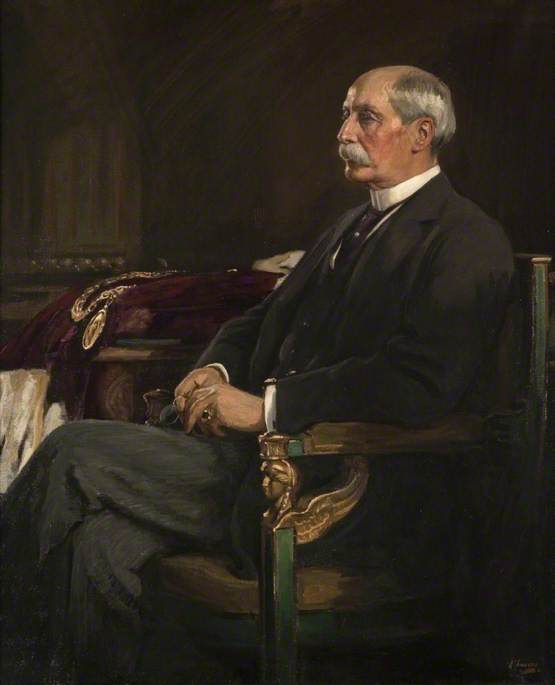
Sir James Watson Stewart
The Forty-Hour strike began on the 27th of January 1919. On the 29th of January, a deputation from the strikers met with the Lord Provost of Glasgow, Sir James Watson Stewart. The deputation wanted him to contact the Prime Minister and ask him to impose a forty-hour working week. Furthermore, they threatened to go beyond constitutional methods should the government not meet their demands, although they promised to hold off taking any action until Friday 31st of January (Barclay, "Duties in Aid of the Civil Power", p.267).


How the strike leaders planned to escalate was hinted at in a speech Shinwell and Gallacher gave to supporters, in which they threatened to “stop every tramcar, shut off every light and generally paralyse the business of the city”(quoted in Barclay, "Duties in Aid of the Civil Power", p.268).

The Cabinet discussed the matter on the 30th of January. They agreed that the Scottish Office would send a senior official, John Lamb, to Glasgow to keep the government informed of events, but they refused to intervene in the dispute between employees and employers. This refusal to meet the strikers’ demands was reported in the 31st of January edition of the Glasgow Herald newspaper (Barclay, "Duties in Aid of the Civil Power", pp.274-5).

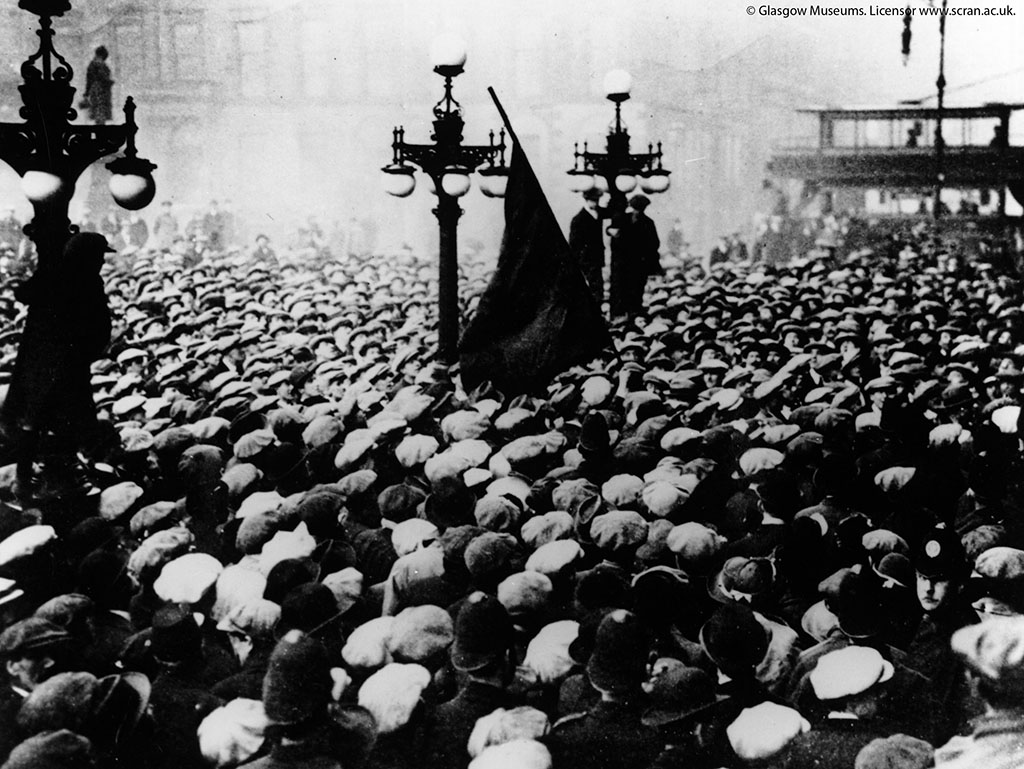
On the morning of the 31st of January, the deputation returned to the City Chambers in George Square for a follow-up meeting with the Lord Provost. While they were there, the Police baton-charged the crowd of striking workers that had gathered outside. This was poorly judged and provoked the crowd to riot. Seeing the violence unfold from the windows of the City Chambers, two magistrates went outside to try and “quieten” the mob but were unsuccessful. The crowd by this point had armed themselves with bottles and had started pelting the police and civic authorities who exited the City Chambers. The Sheriff of Lanarkshire decided to read the Riot Act, thereby making the assembly unlawful. As he read it he was hit by glass bottles and, to add insult to injury, his copy of the legislation was stolen by a member of the crowd. One member of the deputation, David Kirkwood, ran outside the City Chambers and was beaten unconscious by a policeman. Gallacher punched the Chief Constable in the face and was also beaten up by policemen. Eventually, Shinwell, Kirkwood, and Gallacher were arrested (Read, World on Fire, pp.87-88; Barclay, "Duties in Aid of the Civil Power", pp.275-7).

Kirkwood lies unconscious after being assaulted by police.

The riotous crowd disappeared down the various streets connected to George Square, smashing windows and looting businesses as they went. They continued to pelt bottles at the police and overturned over two dozen city trams. This riot became known as the Battle of George Square.

The situation panicked the Scottish Secretary, who at a Cabinet meeting that same day gave his opinion that “it was a misnomer to call the situation in Glasgow a strike- it was a Bolshevist rising” (quoted in Barclay, "Duties in Aid of the Civil Power", p.278).

About 10,000 soldiers were sent to Glasgow but they did not arrive until the violence had largely dissipated. Contrary to the myth, the soldiers did not put down the riot. Gordon J. Barclay quotes several contemporary accounts supporting this claim, including the Daily Record on the 1st of February:

The disturbances were all at an end for the day when the first detachment of the troops arrived. The soldiers reached Queen Street station shortly after ten o’clock, and from that hour until the early morning there was a constant stream of men fully equipped for all emergencies (Quoted in Barclay, "Duties in Aid of the Civil Power", p.280).

Far from fighting with strikers and demonstrators, or even cracking the skulls of looters, there isn’t any record of a civilian being assaulted, let alone killed, by any soldier. What the troops did was recorded in The Observer on Sunday the 2nd of February:

The military is now in full possession of the more important points of the city, such as City Chambers, the Post Office, the railway stations, river bridges and electric power stations. The City Chambers is like an armed camp. The quadrangle is full of troops and equipment, including machine guns, as also are the corridors upstairs (Quoted in Barclay, "Duties in Aid of the Civil Power", p.281).

Tanks didn’t arrive until the 3rd of February and they stayed in their depot in the Cattle Market (quoted in Barclay, "Duties in Aid of the Civil Power", p.284).

The soldiers were not in Glasgow to suppress the strike. This is demonstrated by the fact that it continued for almost two weeks after the soldiers arrived in Glasgow, ending on the 12th of February (Barclay, "Churchill Rolled the Tanks", p.38).

Historian Iain McLean has highlighted that blaming the military occupation for the failure of the strike was a convenient way for those leading the strike to explain its defeat. In fact, the reasons for its demise lay elsewhere:

It may be argued that the Government's firm stand in 1919 prevented any resurgence of revolutionary, anti-official militancy. But that is to forget the structural weakness of the strike. It would certainly have collapsed, and discredited unofficial action, without any help from the Government. Indeed, the net effect of the tanks in the Cattle Market was probably the same as that of the police misbehaviour in George Square: it gave the strike a romantic history which successfully concealed an otherwise ignominious failure (McLean, Legend of Red Clydeside, p.138).

What was Winston Churchill’s Role and Responsibility?

Contrary to the suggestion that Churchill despised trade unionism and was chomping at the bit to send in the military to deal with the strikers, he was in fact one of the more moderate voices in the Cabinet. Before the strike began, Cabinet Secretary Maurice Hankey wrote that:

The ministers…seem to have the ‘wind-up’ to the most extraordinary extent about the industrial situation. C.I.G.S [Chief of the Imperial General Staff Field Marshall Sir Henry Wilson] also is positively in a state of dreadful nerves on the subject. Churchill is the only one who is sane on this subject (quoted in Barclay, "Duties in Aid of the Civil Power", p.267).

At the Cabinet meeting on the 30th of January, Churchill cautioned that “we should not exaggerate the seriousness of this disturbance’. He regarded the "disaffected" as a minority. While Churchill did think that a conflict would be needed to “clear the air” he added that “strong measures” would require “plenty of provocation”. The time to use troops “had not yet arrived”, in his opinion. According to Gordon J. Barclay, Churchill stressed that the Government “should not act in advance of public opinion" (Barclay, "Duties in Aid of the Civil Power", p.271).

At the Cabinet meeting the following day, after the Battle of George Square had taken place, Churchill made no substantial contribution to the discussion. He only commented on the authority required before the strike leaders could be arrested. Unlike the Secretary of State for Scotland, Churchill did not describe the situation as a Bolshevik or communist revolt (Barclay, "Duties in Aid of the Civil Power", p.278).

Neither Churchill nor the Cabinet sent the troops to Glasgow. Under the King's Regulations and Orders for the Army, the military could not send troops to support law and order without a written request from the appropriate civil authority. In the case of Scotland, this was the local county Sheriff. It was up to the army commanders to determine what and how many troops they would send but they could not be sent without being first invited by the appropriate local authority (Barclay, "Churchill Rolled the Tanks", pp.37-8).

This is what happened in Glasgow. After reading the Riot Act, after being pelted by bottles, and after seeing the riot unfold, the Sheriff decided to request military assistance. The Sheriff admitted this in his testimony at the trial of the strike leaders:

Q: After reviewing all that you had seen and taken part in that day, did you have a consultation with the Lord Provost and the Chief Constable?

A: Yes, I spoke to both of them.

Q: And did you tell them you had come to the conclusion that the resources of the Civic Authorities were insufficient for securing the maintenance of order in the City at that time?

A: Yes, we were all agreed. We had heard other things of more disorder.

Q: You had heard of disorder in the Trongate and elsewhere?

A: Yes

Q: And did you in consequence make up your mind that the necessity had arisen for appealing to the Military Authorities?

A: Yes (quoted in Barclay, "Duties in Aid of the Civil Power", p.277-8).

In fact, when the Cabinet convened on the 31st of January they were informed that orders had already been set to Scotland for the deployment of troops to Glasgow. To quote Iain McLean:

[T]he Cabinet was not called upon to take new decisions, since the moves to send troops to Scotland had already been put into effect (McLean, Legend of Red Clydeside, p.125).

It is also worth pointing out two things. Firstly, Scottish affairs, let alone Scottish labour affairs, were not within Churchill’s purview as Secretary of State for War. At the Cabinet meeting on the 30th of January the Deputy Prime Minister, Andrew Bonar Law, said that the “first responsibility in the whole matter must be by the Secretary of Scotland” (quoted in Barclay, "Duties in Aid of the Civil Power", p.269).

Secondly, Churchill actually admired one of the leaders of the strike, David Kirkwood. He even went so far as to write a foreword for Kirkwood’s 1935 autobiography My Life in Revolt.

Note the foreword by Churchill

Conclusion

The Forty-Hour Strike and the Battle of George Square are surrounded by mythology. For people who are politically left-wing, it provides an example of Churchill’s alleged ruthlessness in dealing with the working class. Scottish nationalists take the events as an instance of Churchill oppressing the Scots. However, the mythology is just flat-out untrue.

Churchill did not send troops to Glasgow to suppress a strike. The local authorities in Glasgow requested military aid. They did so not because there was a strike, but because a riot had broken out and they were not sure that the forces they had at their disposal would suffice to maintain law and order. Churchill’s department was not responsible for the situation. The Scotland Office was. Churchill was not antagonistic towards the strikers and was in fact a moderate voice in the Cabinet. When they did arrive in Glasgow, the troops guarded important infrastructure in the city but there is no record of them hurting or even killing anyone. Their presence did not end the strike, which continued for almost two weeks after their arrival.

Bibliography

Barclay, Gordon J., "'Churchill Rolled the Tanks into the Crowd': Mythology and Reality in the Military Deployment to Glasgow in 1919", Scottish Affairs, Vol. 28, Issue 1, pp.32-62 (2019)

Barclay, Gordon J., "'Duties in Aid of the Civil Power': The Deployment of the Army to Glasgow, 31 January to 17 February 1919", Journal of Scottish Historical Studies, Vol. 38, Issue 2, pp.261-92 (2018)

McLean, Iain, The Legend of Red Clydeside (John Donald Publishers Ltd, 1983)

Read, Anthony, The World on Fire: 1919 and the Battle with Bolshevism (Pimlico, 2009)

Fallacies of a Fundamentalist

Occasionally he stumbled over the truth, but hastily picked himself up and hurried on as if nothing had happened – Winston Churchill, 1936 (...