Showing posts with label Perfidious Otto. Show all posts

Friday, December 16, 2022

Otto vs Details

Despite being a brave defender of the truth Otto English (né Andrew Scott) has some difficulty with some tricky details. The spelling of the surname of the Labour Party leader in 1945, for example:


Fun fact: "Atlee's" name is actually spelled "Attlee".


Wednesday, September 7, 2022

Wiseacre

 In his Fake History, Otto English (né Andrew Scott) dismisses many of the books written about Churchill as full of “things [Churchill] never said”. He spends a good deal of his essay on Churchill debunking quotations and statements that have been misattributed to Churchill. This should be low-hanging fruit for English as there are plenty of quotations that have been misattributed to Churchill over the years. However even here English makes mistakes. Consider his take on what is arguably Churchill’s most famous retort.


In fact, we know Churchill made the “in the morning I will be sober” retort to Bessie Braddock because there was a witness.

Not original to Churchill, but world-famous and confirmed by Ronald Golding, a bodyguard present on the occasion, as WSC was leaving the House of Commons. Lady Soames, who said her father was always gallant to ladies, doubted the story – but Golding explained that WSC was not drunk, just tired and wobbly, which perhaps caused him to fire the full arsenal. However, he was relying on his photographic memory for this riposte: in the 1934 movie It’s a Gift W.C. Field’s character when told he is drunk, responds, “Yeah, and you’re crazy. But I’ll be sober tomorrow and you’ll be crazy the rest of your life" (Langworth, Churchill by Himself, p.550).

I have no idea where English got the idea that Churchill was averse to wisecracks. 


Bibliography

Langworth, Richard (ed.), Churchill by Himself: The Definitive Collection of Quotations (Public Affairs, 2008)

Tuesday, September 6, 2022

Close but No Cigar

 One of the more amusing errors Otto English (né Andrew Scott) makes in his essay on Churchill concerns Churchill’s time in Cuba.


Otto is right to describe Churchill as an “observer”, but he drops the ball by saying that Churchill was “fighting for the [Spanish]” and was “awarded his first medal… for helping the Spanish suppress the [Cuban] revolt”. Churchill was, as Otto writes, an observer. That means he was a spectator, not a participant. D'Este outright calls him a “non-combatant” (D’Este, Warlord, p.46). He never even fired a shot at the rebels during his time in Cuba. Churchill did not receive the Cross of the Order of Military Merit for taking part in skirmishes with the Cuban insurgents, he got it as a courtesy (Russell, Soldier, p.130). 

The only narrative spoiled is the narrative that English has crafted about himself – that he is a careful and diligent writer who is “toppling fake history from the plinth” and raising up the truth in its place.

Bibliography

D'Este, Carlo, Warlord: A Life of Churchill at War 1874 - 1945 (Allen Lane, 2009)

Russell, Douglas S., Winston Churchill, Soldier: The Military Life of a Gentleman at War (Conway, 2005)

Wednesday, April 13, 2022

Besieging Fake History

 Otto English’s description of the Siege of Sidney Street is laughably bad:


In a footnote he adds the following description of the event: 

Where to start with this?

Problem #1: English Confuses Two Separate Incidents

The gunfight on Sidney Street in January 1911 did not result in the deaths of three policemen. No policemen were killed during the Siege of Sidney Street. One policeman was seriously wounded in the gunfight – Sergeant Ben Leeson – and had to retire. He published his memoirs, Lost London, in 1934.

Three policemen - Sergeants Tucker and Bentley and Constable Choate – were murdered by the criminal gang but not during the Siege of Sidney Street. Their killings took place a month earlier, in December, in Houndsditch. 

Not to be confused with the Siege of Sidney St

Problem #2: English is Wrong About the Number of Gangsters Killed

Only two gangsters were killed in the gunfight, not three. Their names were Fritz Svaars and Joseph Sokoloff. One was killed by bullets and the other suffocated in the smoke. Another member of the gang – George Gardstein – had been killed by police during the earlier Houndsditch incident.

Problem #3: English is Wrong About Churchill's Initial Reaction

Churchill did not “hot foot” it down to Stepney when he heard about the gunfight. He was first notified of the battle when he was in his London home – 33 Eccleston Square. Churchill “hot footed it” to the Home Office. However, there were no additional updates there. It was only then that he decided to go see events for himself. 

Problem #4: Churchill Didn't Take a Photographer With Him

At one point English mentions the work of Churchill's greatest biographer -  Martin Gilbert. It seems that English didn't bother to read Gilbert's work though. If he had he wouldn't have made this mistake. Churchill did not take a photographer with him to Sidney Street. Churchill himself mocked the suggestion that he did:

I am sure he [Alfred Lyttelton] does not suppose there is a branch of the Home Office to organise the movements of photographers. It is the misfortune of a good many Members to encourter in our daily walks an increasing number of persons armed with cameras to take pictures for the illustrated Press which is so rapidly developing. I would remind the right hon. Gentleman that his own Leader (Mr A.J. Balfour), when he risked his valuable life in a flying machine was the victim of similar publicity, but I certain should not go so far as to imitate the right hon. Gentleman (mr Lyttelton) by suggesting that he was himself concerned in procuring the attendance of a photographer to witness his daring feat in the way of aerial experience (quoted in Gilbert, Churchill: A Life, p.229)

Problem #5: Churchill Didn't Take Charge of the Police Operation

Churchill did not make a "show" of taking charge of events. To quote an eyewitness to the event, Sydney Holland:

The only possible excuse for anyone saying that [Churchill] gave orders is that [he] did once and very rightly go forward and wave back the crowd at the end of the road.... and you did also give orders that [he] and I were not to be shot in our hindquarters by a policeman who was standing with a 12-bore behind [us]” (quoted in Gilbert, Churchill: A Life, pp.223-224).

  Churchill also was approached by a junior firefighter and asked to overrule a police command for the fire brigade to stay back. Churchill declined to do so (or rather, he instructed the Fire Brigade to wait) because of the danger from gunfire. But this hardly amounted to him taking command of the police operations. Donald Rumbelow, a former curator of the City of London’s Police Museum, wrote that:

"[Churchill] had no wish to take personal control but his position of authority inevitably attracted to itself direct responsibility. He saw that he would have done much better to have remained in his office but it was impossible to get into his car and drive away while matters were so uncertain and – he wrote later – so ‘extremely interesting’" (Rumbelow, The Houndsditch Murders, p.136; emphasis added).

Problem #6: English Gets the Cause of the Fire Wrong

English's attribution of the cause of the blaze to artillery shot is contradicted by two eyewitness accounts. According to firefighter Cyril Morris, the opinion of the fire brigade was that the fire was caused by a bullet hitting a gas pipe:

We found two charred bodies in the debris, one of them had been shot through the head and the other had apparently died of suffocation. At the inquest a verdict of justifiable homicide was returned. Much discussion took place afterward as to what caused the fire. Did the anarchists deliberately set the building alight, thus creating a diversion to enable them to escape? The view of the London Fire Brigade at the time was that a gas pipe was punctured on one of the upper floors, and that the gas was lighted either at the time of the bullet piercing it or perhaps afterwards by a bullet causing a spark which ignited the escaping gas (Morris, Fire!, p.39).

Journalist Philip Gibbs, who witnessed the event from a nearby pub, wrote that the fire was actually caused by the criminals themselves:

In the top-floor room of the anarchists' house we observed a gas jet burning, and presently some of us noticed the white ash of burnt paper fluttering out of a chimney pot.

"They're burning documents," said one of my friends.

They were burning more than that. They were setting fire to the house, upstairs and downstairs. The window curtains were first to catch alight, then volumes of black smoke, through which little tongues of flame licked up, poured through the empty window frames. They must have used paraffin to help the progress of the fire, for the whole house was burning with amazing rapidity (Gibbs, Adventures in Journalism, p.67).

In fact, it would have been extremely difficult for the Royal Artillery to cause the fire because they didn't shell the street. The fire started around 1 PM (Rumbelow, The Houndsditch Murders, p.136), and the artillery did not arrive until c.2:40 PM, around the same time Churchill left the scene. Martin Gilbert records Churchill's denial that he ever called up the artillery (Gilbert, Churchill: A Life, p.224).

Churchill's testimony at the inquest. Note the artillery arrived after the fire had already started

Conclusion: Fake History

In the span of several sentences, English managed to make six incorrect assertions. Had he just looked at the Wikipedia page he could have avoided this. A poor effort for someone claiming to debunk “fake history”.  

Bibliography

Gibbs, Philip, Adventures in Journalism (Harper & Brothers, 1923)

Gilbert, Martin, Churchill: A Life (Pimlico, 2000)

Morris, Cyril Clarke Boville, Fire! (Blackie and Son Ltd, 1939)

Rumbelow, Donald, The Houndsditch Murders and the Siege of Sidney Street (The History Press, 2009)

Sunday, October 17, 2021

In the Trenches

Otto English (né Andrew Scott) is a journalist who has recently published a book on historical myths. He devotes one whole chapter to what he regards as the myth that Churchill was Britain’s greatest Prime Minister. His book has not been well received by historians, with one describing it as among the “worst books about history I have ever read”. In spite of this though, his book is a bestseller on Amazon, ranking in the top ten in the category of “World History”.


Judging by the reviews, many of his readers are accepting Otto English’s arguments hook, line and sinker. “Well written, balanced, and fair””, says one. “Interesting, informative and irreverent" says another. “[A] brilliant exposure of the lies we are exposed to daily about our past” says another. Laypeople are taking Otto English seriously. So, despite his work not being proper history but merely political polemic (as some of his defenders suggest) it is worth responding to.

Mr. English clearly thinks he is a brave defender of the “truth” (no joke, he actually believes this). For him, the idea that Churchill was a great Prime Minister is propaganda being used by Brexiteers and Tories. He seems particularly irked by the current UK Prime Minister’s biography of Churchill. In fact, English’s guiding principle when writing his own book seems to have been “if the Prime Minister says X, then X never happened”. 

Now, for the record, I have not read Boris Johnson’s biography of Churchill. I likely never will. English is so blinded by his dislike of him though that he makes some egregious errors. In fact, he goes further than that. A close examination reveals that Otto English is deliberately misleading his readers by presenting half-truths and lying by omission. I will demonstrate this by reviewing his treatment of Winston Churchill’s time on the Western Front during the First World War.

Otto English on Churchill in the Trenches

For years people accepted that Churchill’s service in the army in 1915 and 1916 was to his credit. But we’ve been misled, according to English. He writes that Churchill was never really in any danger as he was posted to a quiet part of the front, miles away from the “actual war”. It is highly unlikely he ever ventured into No Man’s Land. He spent his time strutting around in an Adrian helmet, making his men practice marching (badly), writing letters, and painting watercolour. He dismisses as a “complete fabrication” the idea that Churchill was in danger. As a commander of troops Churchill proved incompetent so it was probably a good thing for the men that they were miles away from the front line with Churchill.

Anyone even remotely familiar with Churchill’s time on the Western Front will recognize this as downright wrong. It’s so wrong a reader might think I am strawmanning him. I am not. 


English goes on to say that after a few months Churchill got “bored stiff” of being a soldier and decided to leave the war after a few months.

But if Otto English’s characterization of Johnson’s description of Churchill’s time at the front is anything to go by, Johnson produced a more careful and accurate book than Otto English’s Fake History. (Lest anyone take this as an endorsement of Johnson, please see this review by Richard Evans.)

What Otto English Gets Correct

Otto English isn’t completely wrong. A few things he writes are correct. However, this is highly revealing as to his methodology. For example, Churchill did, on one occasion, erroneously give a cavalry command to the infantry, causing them confusion. The late military historian, Carlo D’Este, described it thus:

The 6th Fusiliers were assembled on a slope when Churchill appeared riding his black charger and began barking out commands: ‘Royal Scots Fusiliers! Fix Bayonets!’ The whole scene was farcical: ‘The command could not possibly be carried out from the slope position. A couple of the chaps put their rifles on the ground and pulled out their bayonets; the rest were merely mystified. Eventually [Captain] Gibb persuaded Churchill to call “Order Arms” and to fix their bayonets in the normal way. Winston then inspected the men. Having done so, he gave a cavalry order: “Sections Right!” This meant nothing to the Jocks [Scots], who had the sense to stand still and do nothing.’ (D’Este, Warlord, p.313)

Oops. Pretty embarrassing, still no real harm done. Churchill himself was a cavalryman originally, and since took place on his first day with Fusiliers we can probably cut him a little slack.

It is also true that Churchill wore a French helmet, an Adrian helmet. He also found a little time to do some painting. However, there is much more to the story. The fact that Mr. English gets these details right suggests that he has done some research on this aspect of Churchill’s life. This also makes sit inexcusable that he only discusses these aspects. English is clearly trying to spin a narrative and in doing so is deceiving his readers.

English is right to describe how Churchill’s experience at the front as a Member of Parliament was not unique. Churchill was not the only MP to see combat in World War One. A number of MPs were killed in action. But, did anyone ever claim otherwise? Not as far as I know. English is tilting at windmills here. I am not sure that Churchill and other MPs are on a reputational seesaw. It doesn’t take anything away from Churchill that other people saw more combat during the First World War than Churchill did.

Why Churchill Left for the Front

In May 1915, Churchill resigned as First Lord of the Admiralty, scapegoated for the failures of the Dardanelles campaign. In November the same year, he resigned from the Cabinet. Churchill was left with two options – either do nothing and retire or re-enlist in the army and serve his country on the battlefield. In fact, there is reason to believe that Churchill had always intended on re-joining the army eventually. In 1914 he wrote to his brother Jack that:

As soon as the decisive battle has been fought at sea – I shall try to come out to; if there is any use for me (quoted in Russell, Soldier, p.359).

After Gallipoli, when he was no longer able to influence the grand strategy in London, he likely decided that he was of best use to his country in the army. As he put it in a letter to Curzon:

I did not go [to the front] because I wished to disinterest myself in the great situation or because I feared the burden or the blow: but because I was and am sure that for the time being my usefulness was exhausted & that I cd only recover it b a definite & perhaps prolonged withdrawal (quoted in Russell, Soldier, p.376)

Churchill's Experience at the Front

Otto English is wrong to suggest that Churchill spent barely any time at the front. Deducting time spent on leave and in the rear, historian Paul Addison estimated that Churchill spent roughly one hundred days on the front line (Addison, Unexpected Hero, p. 84)

On November 18th Churchill arrived in France. He was immediately (and unexpectedly) taken to see General Sir John French, C-in-C of the British Expeditionary Force. The General thought very highly of Churchill and offered him a promotion to Brigadier General and command of an infantry brigade. Churchill accepted, but suggested that before he assume command, he should spend time at the battalion level so he might be educated in the ways of trench warfare. The General agreed and Churchill was to train for the next few weeks with the Grenadier Guards. The troops rotated between 48 hours in the front line then 48 hours in support for 12 days followed by six days in divisional reserve (Russell, Soldier, p.362).

Douglas S. Russell describes Churchill’s time at the front line with the Grenadier Guards as a time when he faced “constant danger” (Russell, Soldier, p.362). Churchill didn’t face the occasional “stray bullet” or “rogue shell”. He faced daily rifle, machine gun, and artillery fire. According to Russell, it was quite normal for several soldiers to be killed or wounded each day. On the 25th of November 1915, Churchill experienced a near-miss when a dugout he had been in was destroyed by German artillery fire minutes after he had exited it (Russell, Soldier, p.363; D’Este, Warlord, p.305-306).

In January 1916 Churchill was assigned to the IX (Scottish) Division and given command of the Sixth Battalion, Royal Scots Fusiliers. His battalion spent the first few weeks of January at a French village called Moolenacker. There Churchill was responsible for drilling and training the men. Contrary to the impression English gives, Churchill did not prove “rusty” as a commander. This period is actually very well documented as the officers who served under him wrote about it too. One of them, Andrew Dewar Gibb – who would later go on to found the Scottish National Party – wrote a memoir of his time at the front with Churchill. According to Gibb:

From day to day [Churchill] introduced particular little innovations which he liked and by the end of ten days he had produced a manifest smartening up on every side… it is only just to admit he improved us greatly (Gibb, With Winston on the Front, p.24).

Carlo D’Este writes that Churchill:

Immersed himself in every aspect of [the soldiers] daily lives. Changes were made, improvements initiated, and constant, almost incessant lectures delivered on a variety of subjects. There did not seem to be a single topic with which Churchill was not conversant. The men smartened up, and a sense of order and purpose emanated from the confidence displayed by their leader (D’Este, Warlord, p.314).

On January 26th the battalion took over a section of the trenches near the town of Ploegsteert. While it is true that this was a comparatively quiet section of the front, it is completely misleading to describe this as being miles away from the “actual war”. The 6th Royal Scots Fusiliers suffered a twenty percent casualty rate during the following half-a-year (Russell, Soldier, p.374). On the Western Front, it didn’t require a big battle for men to be killed or wounded. Churchill’s battalion would spend six days in the frontline trenches (less than 100 yards from the German trenches) and then six days in the support trenches and rotate back. German artillery fire was a constant risk and Churchill himself was nearly killed on a number of occasions. Russell mentions near-misses on the 3rd of February (when artillery shells exploded in the next room while Churchill was at the battalion HQ), on the 12th of February (while watching an artillery barrage against the German trenches and he was caught in a counter barrage), and on the 16th of February (again while Churchill was in HQ) (Russell, Soldier, p.371-372). This is not a definitive list by any means.

Despite what Mr. English thinks, Churchill also led patrols into No Man’s Land (which he was not obliged to do) (Russell, Soldier, p.373, D’Este, Warlord, pp.319-320). His bravery was remarked upon by the men who served with him. Gibb wrote that “there was no such thing as fear in [Churchill]” (Gibb, With Churchill at the Front, p.68). Lt. Hakewell Smith said:

He would often go into no man’s land. It was a nerve wracking experience to go with him…. He never fell when a shell went off; he never ducked when a bullet went past with its loud crack. He used to say after watching me duck: ‘it’s no damned use ducking; the bullet has gone long past you by now (quoted in Russell, Soldier, p.374).

The exact number of times Churchill did this I am unsure of. Andrew Roberts, says it was more than thirty times (Roberts, Churchill, p.239).

English is correct that Churchill was popular with the men but wrong to suggest this was due to lax discipline. To be generous, there is a kernel of truth in what he says. Other officers, such as Captain Gibb, did think that Churchill was a bit too soft on the men. In March 1916 Churchill actually received a reprimand for “undue leniency” in administering punishments. But what does that actually mean? Unit cohesion never was threatened while Churchill was in charge (Russell, Soldier, p.371). These days we tend to think that First World War discipline was too strict. Maybe Otto English would have been satisfied if Churchill had sent a few shell-shocked teenagers to face a firing squad. But it was not this leniency that won over the men to him. It was mainly his consideration for their needs. Carlo D’Este notes on revealing incident:

[A] company runner, a private named Reginald Hurt, encountered Churchill. After saluting… the soldier was asked why he was limping. ‘I explained that my feet were sore because of the bad condition of my boots and that when I had applied for new pair [sic] the quartermaster said they would last another three months. The OC [Churchill] took a letter from his tunic pocket, detached the envelope and rote on it, “Quartermaster Sgt. B. Company, supply bearer with one pair of boots immediately” and signed it’. For Churchill it was small but important gestures like this that won the confidence of his men (emphasis in original; D’Este, Warlord, p.316).

While Otto English sneers that Churchill taught the men “singsongs”, this was actually an important morale booster and shows Churchill’s concern for the men under his command. As far as I know, Otto English has no military experience so perhaps he doesn’t appreciate the importance of songs and music.

Why Churchill Left the Front

Otto English’s explanation for why Churchill returned to politics is perhaps the least charitable one imaginable. He simply got bored. That’s not what happened. Churchill actually found his time on the front rather fulfilling. He was dismayed at what he saw as the incompetence of those in charge of Britain’s war effort and came to believe that he could do more for the war effort in Parliament. As he put it to his wife “there I can help the movements of events” (quoted in Russell, Soldier, p.375).

The Last Words

For all his claims about being a defender of “the truth”, from my point of view, the truth is that Otto English is deliberately misleading his readers. There is no way he could have done enough research to include those piquant details that made Churchill look bad, without realizing that Churchill did face danger at the front, was a competent commander, and was held in high regard by his men. I’ll finish this post by quoting some of the men who served in the trenches with Churchill. I don’t think they’d share Mr. English’s position:

Captain Jock McDavid:

After a very brief period he had accelerated the morale of the officers and men to an almost unbelievable degree. It was sheer personality. We laughed at lots of things he did, but there were other things we did not laugh at for we knew they were sound. He had a unique approach which did wonders to us. He let everyone under his command see that he was responsible, from the very moment he arrived, that they understood not only what they were supposed to do, but why they had to do it…

No detail of our daily life was too small for him to ignore. He overlooked nothing… Instead of a quick glance at what was being done he would stop and talk with everyone and probe to the bottom of every activity. I have never known an officer take such pains to inspire confidence or to gain confidence; indeed he inspired confidence in gaining it (quoted in Russell, Soldier, p.377).

Captain Gibb:

I am firmly convinced that no more popular officer ever commanded troops. As a soldier he was hard working, persevering, and thorough… He was out to work hard at tiresome but indispensable detail and make his unit efficient in the very highest possible degree… We came to realise, to realise at first hand, his transcendent ability… And much more, he became our friend. He is a man who is apparently always to have enemies. He made none in his old regiment, but left behind him, there  men who will always be his partisans and admirers, and who are proud of having served in the Great War under the leadership of one who is beyond question a great man (quoted in Russell, Soldier, p.377).

Colonel Seely:

The one vital essential quality in any great commander of men in real war… That quality is cool courage and unimpaired judgment under fire… seeing his men, being seen by them [and inspiring them] with his own will for victory. Churchill had this quality in high degree. Real danger unnerves most men; it nerved him (quoted in D’Este, Warlord, p.327).

Brigadier General Croft:

[T]he Service lost a good soldier when Winston took to politics (William Denman Croft, Three Years with the 9th (Scottish) Division, p.27)

Bibliography

Addison, Paul, Churchill: The Unexpected Hero (Oxford University Press, 2006)

Croft, William Denman, Three Years with the 9th (Scottish) Division (John Murray, 1919)

D’Este, Carlo, Warlord: A Life of Churchill at War 1874  - 1945 (Allen Lane, 2009)

Gibb, Andrew Dewar, With Winston Churchill at the Front: Winston in the Trenches 1916 (Frontline Books, 2016)

Roberts, Andrew, Churchill: Walking with Destiny (Penguin, 2019)

Russell, Douglas S., Winston Churchill, Soldier: The Military Life of a Gentleman at War (Conway, 2005)


Wednesday, September 15, 2021

Otto English Busted

Otto English (né Andrew Scott) doesn’t like what he calls “fake history”. He hates it so much he has written a book called Fake History, wherein he tries to describe and debunk “ten great lies and how they shaped the world”. Of Winston Churchill, Mr. English writes

Hero-fashioning is all in the edit. Churchill the racist, Churchill the useless post-war leader and Churchill the suppressor of Irish, Kenyan and Indian freedom has to be left on the cutting room floor if the legend is to work” (English, Fake History, p.34)

However, in promoting this alternative Churchillian black legend, Mr. English – like so many before him– has to resort to some careful editing of his own. In their case, it involves adding debunked tall tales to Churchill’s record. He writes:

On becoming President of the United States in 2009, one of Barack Obama’s first acts was to remove a bust of Churchill from the Oval Office. At the time he claimed he was simply returning it to its original place elsewhere in the White House. But it cannot have been a coincidence that Obama’s own grandfather was a survivor of what has been dubbed “Britain’s gulag” in 1950s Kenya during Churchill’s second term of office as Prime Minister” (English, Fake History, pp.33-34).

English doesn’t give any citations for this claim (at least in the version I am reading). But I can’t really blame him. It has been reported time and time again that Obama removed the bust of Churchill from the Oval Office. It has been alleged that he did this because he disliked Churchill because his paternal grandfather, Hussein Onyango Obama had been imprisoned and tortured in colonial Kenya while Churchill was Prime Minister. It’s common knowledge, right

Wrong. Shockingly the book Fake History contains some fake history of its own. There are several problems with this theory:

Problem #1: Obama Actually Likes Churchill

Not much else to say here. Obama is reported as saying “I love Winston Churchill. Love the guy.” He has also quoted Churchill (or claimed to quote Churchill) several times throughout his Presidency.

Problem #2: Churchill was Not Kicked Out of the White House

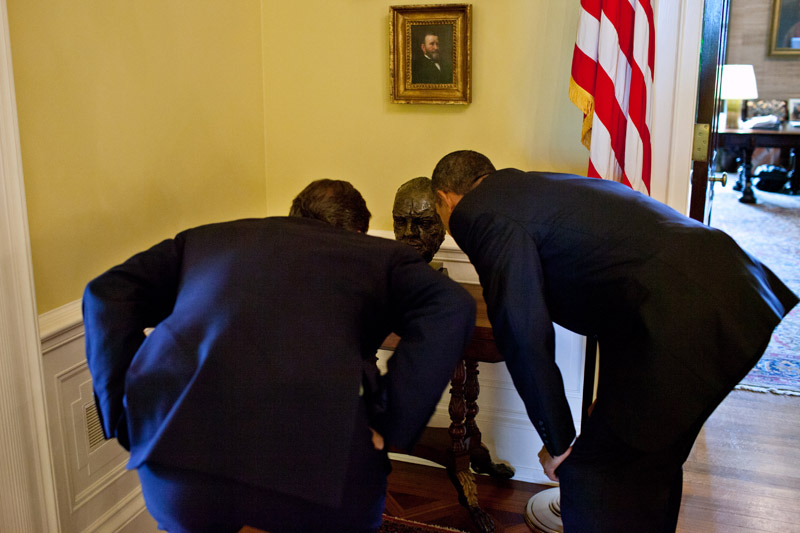
Well, not entirely. In 2001 then-President George W. Bush received a loan of a Jacob Epstein bust from the British Embassy in Washington DC. This loan expired in 2008 and the incoming administration did not take up an offer to extend the loan. However, another bust of Churchill, in the Treaty Room, remained in the White House throughout Obama’s term of office. Obama said he saw it every single day he was working there:

“I see it every day — including on weekends, when I’m going into that office to watch a basketball game,” Obama said. “The primary image I see is a bust of Winston Churchill.”

Problem #3: The Return of the Bust was Expected and had Nothing to do with Churchill Per Se

Obama, being an African American, thought it was appropriate that he honour the memory of people who struggled and gave their lives for the rights of African Americans. Initially, it was reported that Obama was making space for a bust of Abraham Lincoln but then later it was reported that he was making space for Martin Luther King Jr. This seems pretty reasonable to me, and it takes a very Anglo-centric person to regard this reason as a slight on either Britain or Churchill. The British Ambassador at the time did not regard it as a dig at Britain:

Sir Peter Westmacott, who next month finishes his stint as British ambassador to “the single most important country in the world”, says the bust was only ever on loan as a personal gift from Tony Blair to George W Bush for the duration of his presidency.

“So, to be honest, we always expected that to leave the Oval Office just like everything else that a president has tends to be changed,” he explained in a valedictory interview with the Guardian. “Even the carpet is usually changed when the president changes.”

Unfortunately, you can only have so many busts before the Oval Office furniture looks untidy.

“There are only so many tables where you can put busts,” he [Obama] said. “Otherwise, it looks a little bit cluttered.”

Problem #4: Obama’s Grandfather Probably Wasn’t Imprisoned

For all the times this story has been repeated you’d think journalists would, I dunno, check the veracity of the claim that Hussein Onyango Obama was imprisoned. David Maraniss, in his biography of Barack Obama, noted that that numerous associates of Onyango Obama denied that he was ever imprisoned or tortured.

[I]n its specifics the story seems unlikely. There are no remaining records of any detention, imprisonment or trial of Hussein Onyango Obama. Sarah did not witness any of it, and she is the only person to offer details. While there would be no obvious reason for her to contrive such a tale, her accuracy on other matters that can be documented is uneven. She speaks only in Luo, knowing some Swahili and no English, so her quotes are dependent upon the inclinations of the interpreter. And five people who had close connections to Hussein Onyango said they doubted the story or were certain that it did not happen.

John Ndalo Aguk, who worked with him before the alleged incident and kept in touch with him on a weekly basis in Nairobi thereafter, when he was placed in the homes of several employers at Hussein Onyango’s recommendation, said he knew nothing about a detention or imprisonment and would have noticed if his mentor had gone missing for several months. Zablon Okatch, a Luo who worked with Onyango after the supposed incarceration, when they were servants in the house of American embassy personnel, said, “Hussein was never jailed. I know that for a fact. It would have been difficult for him to get a job with a white family, let alone a diplomat, if he once served in jail… All prospective workers had to have details about themselves scrutinized at the Labour Office”. Charles Oluoch, whose father, Peter, had been adopted by Hussein Onyango when he was a young boy, said he doubted the story: “He did not take part in politics, nor did he have any trouble with the government in any way.” Auma Magak, Hussein Onyango’s daughter, disputed the story but offered a different version: “He was not detained. There was an incident where some thugs kidnapped him. He mysteriously disappeared. He was taken to a river where he was tied and left there. Some leopards were around him but left him alone. But the detainment never happened. He was working in Nairobi during those years. He never disappeared [for six months].” Perhaps the most authoritative account disputing Sarah’s story came from Dick Opar, who went on to become a senior police official in Kenya. “At that time, I would have known”, Opar said. “It may have been a day or two. People make up stories. If you get arrested for another thing. No. No. I would have known. I would have known. If he was in Kamiti prison for only a day, even if for a day, I would have known.” (Maraniss, Barack Obama, pp.54-55)

Maraniss also pointed out:

Several pieces of logic contradict the story. First if Hussein Onyango had been imprisoned, even if one were to further accept that he was eventually cleared of whatever charges were against him, he likely would have had difficulty, as Zablon Okatch noted, securing employment in the homes of security-conscious white officials in the following years, when the country was in turmoil and there were increasing concerns about the motives and loyalties of Kenyan workers. Yet he continued to be hired throughout the next decade…. Second, it is also unlikely that his son would have been accepted into the most prestigious boarding school in western Kenya within a year of his father’s imprisonment, or that after many months without a salary the family would have been able to afford the tuition” (Maraniss, Barack Obama, pp.55-56)


So, to sum up, the story that Obama’s grandfather was imprisoned and tortured has:

  • No documentary evidence supporting it
  • Is contradicted by five people who knew the man
  • Makes it really, really weird that the man was employed by white settlers in subsequent years

Problem #5: Churchill Wasn’t Prime Minister When Obama's Grandfather was Allegedly Detained

The most glaring problem with the story is that Sarah Onyango Obama, Hussein Onyango Obama’s wife, said that Onyango Obama was arrested and imprisoned in 1949, i.e., while Clement Attlee was Prime Minister and a whole two years before Churchill’s re-election. She claimed that her husband was held for two years. Churchill did become Prime Minister until after the election on the 25th of October 1951. If her story is true (see problem #4) it is likely that he was released while Attlee was still Prime Minister or shortly after Churchill became Prime Minister again. In the former scenario, this story doesn't concern Churchill at all. In the latter scenario then shouldn't Churchill be credited for setting Obama's Grandfather free (assuming the decision to detain one particular African was taken in 10 Downing Street and not in Colonial Kenya)?

Conclusion

For some reason, Otto English is taken seriously, despite being a playwright and not a historian, even by people who are normally pretty sound. It doesn’t take much effort to find the truth about the Returned Churchill Bust fable. That’s all the story is - a fable. Many on the right-wing of the political spectrum bring it up as a jab at Obama and now many on the centre-to-left wing are uncritically repeating it as a dig at Churchill. The fact that English repeated the fable suggests his research isn’t very thorough or he doesn’t really care about inaccurate history, provided the inaccuracies go a certain way. 

Obama and British PM David Cameron admire a bust of Churchill in the White House

Further Reading

Hattem, Julian, Obama denies disrespecting Churchill: I 'love the guy', The Hill, 04/22/16

Maraniss, David, Barack Obama: The Story (Simon & Schuster, 2012)

Fallacies of a Fundamentalist

Occasionally he stumbled over the truth, but hastily picked himself up and hurried on as if nothing had happened – Winston Churchill, 1936 (...