Wednesday, September 15, 2021

Otto English Busted

Otto English (né Andrew Scott) doesn’t like what he calls “fake history”. He hates it so much he has written a book called Fake History, wherein he tries to describe and debunk “ten great lies and how they shaped the world”. Of Winston Churchill, Mr. English writes

Hero-fashioning is all in the edit. Churchill the racist, Churchill the useless post-war leader and Churchill the suppressor of Irish, Kenyan and Indian freedom has to be left on the cutting room floor if the legend is to work” (English, Fake History, p.34)

However, in promoting this alternative Churchillian black legend, Mr. English – like so many before him– has to resort to some careful editing of his own. In their case, it involves adding debunked tall tales to Churchill’s record. He writes:

On becoming President of the United States in 2009, one of Barack Obama’s first acts was to remove a bust of Churchill from the Oval Office. At the time he claimed he was simply returning it to its original place elsewhere in the White House. But it cannot have been a coincidence that Obama’s own grandfather was a survivor of what has been dubbed “Britain’s gulag” in 1950s Kenya during Churchill’s second term of office as Prime Minister” (English, Fake History, pp.33-34).

English doesn’t give any citations for this claim (at least in the version I am reading). But I can’t really blame him. It has been reported time and time again that Obama removed the bust of Churchill from the Oval Office. It has been alleged that he did this because he disliked Churchill because his paternal grandfather, Hussein Onyango Obama had been imprisoned and tortured in colonial Kenya while Churchill was Prime Minister. It’s common knowledge, right

Wrong. Shockingly the book Fake History contains some fake history of its own. There are several problems with this theory:

Problem #1: Obama Actually Likes Churchill

Not much else to say here. Obama is reported as saying “I love Winston Churchill. Love the guy.” He has also quoted Churchill (or claimed to quote Churchill) several times throughout his Presidency.

Problem #2: Churchill was Not Kicked Out of the White House

Well, not entirely. In 2001 then-President George W. Bush received a loan of a Jacob Epstein bust from the British Embassy in Washington DC. This loan expired in 2008 and the incoming administration did not take up an offer to extend the loan. However, another bust of Churchill, in the Treaty Room, remained in the White House throughout Obama’s term of office. Obama said he saw it every single day he was working there:

“I see it every day — including on weekends, when I’m going into that office to watch a basketball game,” Obama said. “The primary image I see is a bust of Winston Churchill.”

Problem #3: The Return of the Bust was Expected and had Nothing to do with Churchill Per Se

Obama, being an African American, thought it was appropriate that he honour the memory of people who struggled and gave their lives for the rights of African Americans. Initially, it was reported that Obama was making space for a bust of Abraham Lincoln but then later it was reported that he was making space for Martin Luther King Jr. This seems pretty reasonable to me, and it takes a very Anglo-centric person to regard this reason as a slight on either Britain or Churchill. The British Ambassador at the time did not regard it as a dig at Britain:

Sir Peter Westmacott, who next month finishes his stint as British ambassador to “the single most important country in the world”, says the bust was only ever on loan as a personal gift from Tony Blair to George W Bush for the duration of his presidency.

“So, to be honest, we always expected that to leave the Oval Office just like everything else that a president has tends to be changed,” he explained in a valedictory interview with the Guardian. “Even the carpet is usually changed when the president changes.”

Unfortunately, you can only have so many busts before the Oval Office furniture looks untidy.

“There are only so many tables where you can put busts,” he [Obama] said. “Otherwise, it looks a little bit cluttered.”

Problem #4: Obama’s Grandfather Probably Wasn’t Imprisoned

For all the times this story has been repeated you’d think journalists would, I dunno, check the veracity of the claim that Hussein Onyango Obama was imprisoned. David Maraniss, in his biography of Barack Obama, noted that that numerous associates of Onyango Obama denied that he was ever imprisoned or tortured.

[I]n its specifics the story seems unlikely. There are no remaining records of any detention, imprisonment or trial of Hussein Onyango Obama. Sarah did not witness any of it, and she is the only person to offer details. While there would be no obvious reason for her to contrive such a tale, her accuracy on other matters that can be documented is uneven. She speaks only in Luo, knowing some Swahili and no English, so her quotes are dependent upon the inclinations of the interpreter. And five people who had close connections to Hussein Onyango said they doubted the story or were certain that it did not happen.

John Ndalo Aguk, who worked with him before the alleged incident and kept in touch with him on a weekly basis in Nairobi thereafter, when he was placed in the homes of several employers at Hussein Onyango’s recommendation, said he knew nothing about a detention or imprisonment and would have noticed if his mentor had gone missing for several months. Zablon Okatch, a Luo who worked with Onyango after the supposed incarceration, when they were servants in the house of American embassy personnel, said, “Hussein was never jailed. I know that for a fact. It would have been difficult for him to get a job with a white family, let alone a diplomat, if he once served in jail… All prospective workers had to have details about themselves scrutinized at the Labour Office”. Charles Oluoch, whose father, Peter, had been adopted by Hussein Onyango when he was a young boy, said he doubted the story: “He did not take part in politics, nor did he have any trouble with the government in any way.” Auma Magak, Hussein Onyango’s daughter, disputed the story but offered a different version: “He was not detained. There was an incident where some thugs kidnapped him. He mysteriously disappeared. He was taken to a river where he was tied and left there. Some leopards were around him but left him alone. But the detainment never happened. He was working in Nairobi during those years. He never disappeared [for six months].” Perhaps the most authoritative account disputing Sarah’s story came from Dick Opar, who went on to become a senior police official in Kenya. “At that time, I would have known”, Opar said. “It may have been a day or two. People make up stories. If you get arrested for another thing. No. No. I would have known. I would have known. If he was in Kamiti prison for only a day, even if for a day, I would have known.” (Maraniss, Barack Obama, pp.54-55)

Maraniss also pointed out:

Several pieces of logic contradict the story. First if Hussein Onyango had been imprisoned, even if one were to further accept that he was eventually cleared of whatever charges were against him, he likely would have had difficulty, as Zablon Okatch noted, securing employment in the homes of security-conscious white officials in the following years, when the country was in turmoil and there were increasing concerns about the motives and loyalties of Kenyan workers. Yet he continued to be hired throughout the next decade…. Second, it is also unlikely that his son would have been accepted into the most prestigious boarding school in western Kenya within a year of his father’s imprisonment, or that after many months without a salary the family would have been able to afford the tuition” (Maraniss, Barack Obama, pp.55-56)


So, to sum up, the story that Obama’s grandfather was imprisoned and tortured has:

  • No documentary evidence supporting it
  • Is contradicted by five people who knew the man
  • Makes it really, really weird that the man was employed by white settlers in subsequent years

Problem #5: Churchill Wasn’t Prime Minister When Obama's Grandfather was Allegedly Detained

The most glaring problem with the story is that Sarah Onyango Obama, Hussein Onyango Obama’s wife, said that Onyango Obama was arrested and imprisoned in 1949, i.e., while Clement Attlee was Prime Minister and a whole two years before Churchill’s re-election. She claimed that her husband was held for two years. Churchill did become Prime Minister until after the election on the 25th of October 1951. If her story is true (see problem #4) it is likely that he was released while Attlee was still Prime Minister or shortly after Churchill became Prime Minister again. In the former scenario, this story doesn't concern Churchill at all. In the latter scenario then shouldn't Churchill be credited for setting Obama's Grandfather free (assuming the decision to detain one particular African was taken in 10 Downing Street and not in Colonial Kenya)?

Conclusion

For some reason, Otto English is taken seriously, despite being a playwright and not a historian, even by people who are normally pretty sound. It doesn’t take much effort to find the truth about the Returned Churchill Bust fable. That’s all the story is - a fable. Many on the right-wing of the political spectrum bring it up as a jab at Obama and now many on the centre-to-left wing are uncritically repeating it as a dig at Churchill. The fact that English repeated the fable suggests his research isn’t very thorough or he doesn’t really care about inaccurate history, provided the inaccuracies go a certain way. 
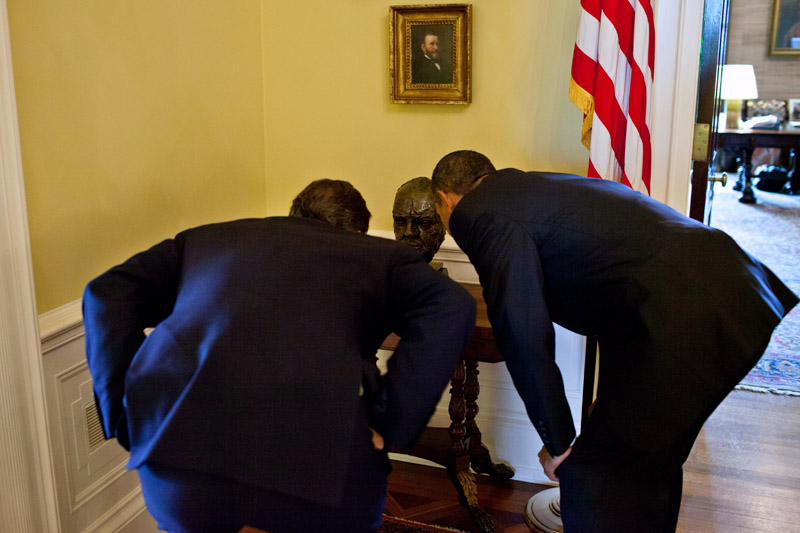
Obama and British PM David Cameron admire a bust of Churchill in the White House

Further Reading

Hattem, Julian, Obama denies disrespecting Churchill: I 'love the guy', The Hill, 04/22/16

Maraniss, David, Barack Obama: The Story (Simon & Schuster, 2012)

Wednesday, September 8, 2021

The Fine Art of Cherry Picking, or Gas in Iraq

One of the more notorious Churchill quotes is usually presented as follows:

I am strongly in favour of using poisoned gas against uncivilised tribes…[It] would spread a lively terror.

This statement appears in Johann Hari’s review of Richard Toye’s book Churchill’s Empire. Hari characterises this as an instance of Churchill demanding that colonial subjects, when they “defied his script…be crushed with extreme force” and that, partly for his view on using gas on “uncivilised tribes”, Churchill was “seen as at the most brutal and brutish end of the British imperialist spectrum”. Shashi Tharoor, in his essay in the Washington Post, includes the aforementioned quote and describes this as the act of a “war criminal”. The BBC placed Churchill’s opinion of poison gas as the second-most controversial aspect of Churchill’s life and legacy. 

In fact, this quotation is a fine example of the fallacy of incomplete evidence, otherwise known as cherry picking. The statement derives from a minute that Churchill wrote in May 1919 (not 1921, despite what Tharoor writes). It reads as follows:

I do not understand this squeamishness about the use of gas. We have definitely adopted the position at the Peace Conference of arguing in favour of gas retention as a permanent method of warfare. It is sheer affectation to lacerate a man with the poisonous fragment of a bursting shell and to boggle at making his eyes water by means of lachrymatory gas.

I am strongly in favour of using poisoned gas against uncivilised tribes. The moral effect should be so good that the loss of life should be reduced to a minimum. It is not necessary to use only the most deadly gasses: gasses can be used which cause great inconvenience and would spread a lively terror and yet would leave no serious permanent effects on those affected (Quoted in Douglas, “Chemical Weapons”, p.861; emphasis added).

Churchill was clearly advocating the use of tear gas (“lachrymatory gas”) and pointing out the absurdity (to him) of causing horrific injuries with conventional weapons yet refusing to employ less harmful chemical weapons. Dr Warren Dockter, of the University of Aberystwyth, summarises Churchill’s position thus:

These memoranda clearly demonstrate that Churchill saw the employment of gas as a tool for controlling ‘native tribes’ and for creating a crisis of morale among the ranks of the dissidents, a concept Trenchard wholeheartedly endorsed. Poison gas was never meant to exterminate frontier tribesmen but it did set a precedent in Churchill’s thinking on colonial air-policing as he would repeatedly return to the use of gas as a relatively humane and inexpensive way to maintain order (Dockter, Islamic World, p.113).

David A.T. Stafford, formerly of the Centre for the Study of the Two World Wars at the University of Edinburgh, describes the interpretation that critics like Hari and Tharoor place on the quote as “far from accurate”. He attributes the continued misrepresentation of the minute to “Churchill’s own confused use of the term ‘poison gas’ when he was referring to non-lethal tear gas and not the far more deadly chlorine or phosgene gas” (Stafford, Oblivion or Glory, p.187).  Here I have to disagree with Stafford. I think many of Churchill’s determined critics – and I include Tharoor in this category without question - are set to despise him come what may. They just don’t seem to care about what Churchill actually said and did.

Churchill’s support for non-lethal gas as a tool of counter-insurgency is impossible to miss if you’ve carefully read what Churchill wrote. Many people online have no intention of doing that and are content to spread misinformation. Of course, the internet is a large space and full of (to quote Chris Snowdon) “bad faith actors, obsessives, bores, pile on merchants, psychopaths and borderline retards”. It isn’t surprising, therefore, to see the misquote still widely used by Churchill's detractors. It is much more concerning that even (semi-)respectable outlets publish dross containing the misquote.

Before moving on, I wish to highlight another example of selective quotation. In his article, Tharoor writes:

 “He [Churchill] wanted to use chemical weapons in India but was shot down by his cabinet colleagues, whom he criticized for their “squeamishness”, declaring that the “objections of the India Office to the use of gas against natives are unreasonable”.

Tharoor however leaves out what exactly Churchill thought was unreasonable. In a minute dated May 29th 1919 Churchill wrote:

If it is fair war for an Afghan to shoot down a British soldier behind a rock and cut him in pieces as he lies wounded on the ground, why is it not fair for a British artilleryman to fire a shell which makes said native sneeze? It is really too silly” (quoted in Douglas, “Chemical Weapons”, p.868-869, fn.39; emphasis added).

Again, Churchill was pointing out the apparent absurdity of using high explosives and machine guns on enemy troops (which the India Office had no qualms about using) while balking at the prospect of using non-lethal chemicals against those same enemy troops.

What Actually Happened in Iraq?

Critics often connect Churchill’s minute of May 1919 to the insurgency in Iraq the following year. Therefore, it is worthwhile discussing what actually happened during that conflict. The rebellion broke out in June 1920. In August, the C-in-C of the British forces in the country – Lt. Gen. Sir James Aylmer Haldane - messaged London requesting that both the Army and the Royal Air Force be given permission to use chemicals weapons – “gas bombs” – against the insurgents. The commander of the local Royal Air Force contingent agreed with Haldane. In London, Haldane’s request was supported by none other than the head of the British Army, Sir Henry Wilson (Douglas, “Chemical Weapons”, pp.872-873).

Churchill considered the matter and agreed in principle. He was, however, bound by a Cabinet decision the prior October that Britain would not initiate chemical warfare but only retaliate in kind. Believing he had found a loophole, Churchill authorised the use of chemical weapons provided they were either in Iraq or in the process of being transported to Iraq. Churchill informed Wilson that:

If gas shell for the artillery is available on the spot or in transit it sh[oul]d certainly be employed in the emergency prevailing. It is not considered that any question of principle is raised by such an emergency use of the limited ammunition of various kinds. As no question of principle is involved there is no need for any special declaration. G.O.C.-in-C. should defend his positions with whatever ammunition is at hand (Quoted in Douglas, “Chemical Weapons”, p.873).

It turned out that there were no gas weapons in Iraq. In September, Haldane had to request the importation of chemical weapons from the nearest source – Egypt. He asked for 5,000 rounds of 60-pounder SK shells and 10,000 rounds of 4.5-inch howitzer shells. Churchill authorised the dispatch (Douglas, “Chemical Weapons”, p.874). Transport difficulties meant that the weapons did not arrive until after the rebellion had been defeated (Douglas, “Chemical Weapons”, pp.882-883).

At the same time, Churchill authorised the Royal Air Force to begin experimental work on producing aerial gas bombs, saying that he wanted them to produce a weapon that would “inflict punishment upon recalcitrant natives without inflicting grave injury upon them” (quoted in Gilbert, “Churchill”, pp.424-425).

The weapons Churchill sent to Iraq were tear gas shells. According to R.M. Douglas, the Russell B. Colgate Distinguished University Professor of History at Colgate University:

The use of gas shells in Iraq albeit containing tear gas rather than poison gas, was indeed sanctioned by the War Office [i.e., Churchill’s ministry] during the emergency of 1920. The decision to do so was taken by Churchill alone, who neither consulted nor even informed his ministerial colleagues – no doubt in view of the certainty that they would have strongly opposed it (Douglas, “Chemical Weapons”, p.874; emphasis added).

Douglas goes on to quote Sir John Salmond, the head of the Royal Air Force in Iraq, as describing SK gas as “Lacrimatory” [sic] and J.A. Webster, assistant secretary at the Air Ministry, as describing the chemical weapon sent to Iraq in 1920 as “definitely classified as non-lethal” (Douglas, “Chemical Weapons”, p. 876). The British Army conducted human trials in Iraq (using their own soldiers as the test subjects) using the 4.5-inch SK artillery shell to determine its effects. It found that the gas irritated the eyes of men even if they were wearing respirators, but within twenty minutes the effects wore off and the subjects could “remove their masks completely and walk about without discomfort” (Douglas, “Chemical Weapons”, p.878).

The Royal Air Force asked permission from Churchill for permission to convert the artillery shells to aerial gas bombs. Tellingly, the case they put across to Churchill stressed the non-lethal effects of aerial gas weapons and made them seem benign. In this respect, they were an improvement even on the artillery shells. Notwithstanding the human trials conducted by the Army, and while conceding that the 4.5-inch shells were “non-lethal” weapons and “far less noxious than even mustard gas”, Webster argued that they potentially could have “serious” and “permanent effects” on eyes and in “some certain circumstances, cause death”. However, “the dropping of these shells from aircraft is definitely less likely to produce fatal results than their discharge from guns, since it would be exceedingly difficult to obtain a concentration sufficient to cause anything more than extreme discomfort” (quoted in Douglas, “Chemical Weapons”, p.876 & 862). If Churchill had been so indifferent to the lives of native tribesmen as often alleged, why did the Royal Air Force feel the need to sell the prospect of aerial chemical weaponry to him by stressing how humane it was?

Churchill declined to make a decision until advised by the British plenipotentiary in Iraq, Sir Percy Cox. Sir Percy talked the issue through with Iraq’s monarch, Faisal I. Faisal had “no objection to the use of gas bombs in Iraq provided that they were not lethal or permanently injurious to health”. Sir Percy recommended the usage of the aerial gas bombs (Douglas, “Chemical Weapons”, p.879).

Having been informed that the SK gas was non-lethal, that aerial bombs were even less dangerous than artillery chemical weapons, and that the Iraq government has no problem with the use of chemical weapons, Churchill authorised the Royal Air Force’s use of those weapons in December 1921. Formal permission was conveyed in January 1922. However, the Royal Air Force could only use it in the defence of “isolated post[s] whose communications are cut and whose existence is threatened”. In any other scenario, the Royal Air Force would need to request permission from the Colonial Secretary before using aerial gas bombs (Douglas, “Chemical Weapons”, p.879).

Two days before Salmond got permission to convert the gas shells to aerial bombs, the Washington Disarmament Conference passed a resolution forbidding the use of chemical weapons of any kind in war, even tear gas. Churchill therefore quickly rescinded his authorisation to the RAF (Douglas, “Chemical Weapons”, pp.879-880).

Churchill in Context

When discussing Churchill, many of his defenders feel the need to suggest he was “a man of his time” or “everyone/ lots of people had similar feelings back in Churchill’s day”. This is often unnecessary as the criticisms are frequently made up out of whole cloth and Churchill’s views seem reasonable by today’s standard, let alone the standard of one hundred years ago.

In this case, though, it is worth discussing the milieu when Churchill made his remarks about chemical warfare for two reasons. Firstly, because many of his detractors claim this as an example of Churchill’s extremism and brutishness that astonished even his contemporaries (e.g., Hari’s remarks quoted above). The second is because the taboo against using any kind of chemical agent is so strong today that it is easy to assume that it was ever thus.

 In regard to this taboo, historian Marion Girard wrote:

The taboo did not develop immediately after World War I in Britain, let alone in the world. Nor was it instinctive; there were many rational arguments for keeping gas in the repertoire of weapons, as Haldane, Churchill, and others demonstrated during the interwar period. The British taboo was not inevitable. If Britain had continued to accept gas rather than reject it, so might the rest of the world. After all, in the decades between the World Wars, Britain was still one of the most influential global leaders. If she had refused to abandon gas, perhaps others would not have embraced arguments against gas and emphasized its negative characteristics. Yet, because they did so strongly, only the destructive story of gas has been remembered and told; the part of its history in which gas has been accepted and even embraced has been forgotten, and thus the taboo seems inescapable (Marion Girard, Strange and Formidable, p.198).

The important thing to remember is that Churchill - and others – had just witnessed one of the most devastating wars in European history. They had seen men’s skin shredded on barbed wire, bones and nerves destroyed by artillery fire, horrendous burns caused by flamethrowers, and bodies riddled by machine gunfire. To many people, gas, especially tear gases, didn’t seem so bad in comparison to conventional weaponry. This was not an opinion unique to Churchill. The General Staff made the same point in March 1919:

If it is advisable and possible to abolish gas on purely humanitarian grounds, the abolition of High Explosive, a far more terrible weapon which removes limbs, shatters bones, produces ‘nerves’, and generates madness, is equally advisable(quoted in Douglas, “Chemical Weapons”, p.867).

At various times, the use of tear gas weapons in Iraq was endorsed by:

  • Field Marshall Sir Henry Wilson, Chief of the Imperial General Staff
  • Lt-Gen Sir James Aylmer Haldane, Commander-in-Chief of the Mesopotamian Expeditionary Force
  • Sir John Salmond, then Air Officer Commanding British Forces in Iraq and later Marshall of the Royal Air Force
  • Sir Percy Cox, High Commissioner of Iraq
  • Faisal I, the King of Iraq

There were other senior colonial officials from elsewhere in the Empire who asked, well into the 1920s, for the Cabinet’s prohibition on the use of non-lethal gas to be set aside. Douglas mentions officials in India, Southern Rhodesia, Nigeria and Egypt asking for this. The Chiefs of Staff, the General Staff and members of the Committee for Imperial Defence also made the same point (Douglas, “Chemical Weapons”, p.881). Authorities in France, South Africa and the United States of America used tear gas “hundreds” of times in the inter-war period (Douglas, “Chemical Weapons”, p.881).

It wasn’t just colonial officials who were in favour of non-lethal gas weapons either. In some respects, gas seemed less cruel than conventional weapons. One of the most brilliant scientists of the 20th century, J.B.S. Haldane, felt very strongly that this was the case and argued in a book titled “Callinicus: A Defence of Chemical Warfare” in 1925 that chemical weapons did not result in a large proportion of combat fatalities (Coleman, History of Chemical Warfare, p.33). “In his opinion, gas did not deserve its status as a pariah among armaments (Girard, Strange and Formidable, p.164). Another scientist, Victor Lefebure, also “believed that gas was a relatively humane weapon, if a humane weapon was one that produced a lower “death rate… [and] a much smaller proportion of the injured suffered any permanent disability”” (Girard, Strange and Formidable, p.179; emphasis in the original).

Conclusion

Many of Churchill’s detractors paint his support for chemical weapons as evidence of a wicked or depraved mind. At the very least, he is alleged to have shown a shocking indifference to the people who would be affected by the weapons. This is ahistorical. Churchill supported the use of tear gas as a tool of counterinsurgency. He never pushed for chlorine gas or phosgene gas to be used in Iraq. In the case of Iraq specifically, he authorized the use of tear-gas weapons. Later on, he approved the development of an aerial tear gas weapon which, the Royal Air Force claimed, was even less harmful. Churchill wanted weapons to be used that would not inflict “grave injury” nor leave “serious permanent effects” on the natives. Churchill’s support for the use of tear gas weapons was supported by numerous senior officials and the Iraqi Government itself, although not the Cabinet as a whole. In the event, tear gas was not used in Iraq and Churchill rescinded his permission to use such weapons. 

Bibliography

Coleman, Kim, A History of Chemical Warfare (Palgrave Macmillan, 2005)

Dockter, Warren, Churchill and the Islamic World: Orientalism, Empire and Diplomacy in the Middle East (I.B. Tauris, 2015)

Douglas, R.M., "Did Britain Use Chemical Weapons in Mandatory Iraq", The Journal of Modern History, Vol. 81, No. 4 (December 2009), pp.859-887

Gilbert, Martin, Churchill: A Life (Pimlico, 2000)

Girard, Marion, A Strange and Formidable Weapon: British Responses to World War I Poison Gas (University of Nebraska Press, 2008)

Stafford, David, Oblivion or Glory: 1921 and the Making of Winston Churchill (Yale University Press, 2019)

Wednesday, September 1, 2021

Churchill's Popularity

Introduction 

In journalism and publishing today there is a cottage industry dedicated to slandering “debunking” Winston Churchill. If one wants to hate Churchill, you don’t need to look for very long before you can find an author attacking Churchill from a particular political perspective you happen to share. However, despite this, a positive view of Winston Churchill is firmly established in the minds of most members of the public. According to YouGov, he is still liked by 64% of the public and only disliked by a mere 12%. In other words, there are more than five times as many Churchill supporters than there are detractors.

But was this always so? Some people lately have claimed that Churchill was actually quite unpopular during his lifetime, including during the Second World War. In order to publicize his latest book, Geoffrey Wheatcroft published an essay in The Times describing him as “unpopular, error-prone and reckless”. Incidentally, this isn’t a bad description of Wheatcroft's book.

Kehinde Andrews, Professor of Black Studies at Birmingham City University, made the same point at a recent panel on the legacy of Churchill:

“It’s actually interesting because at the time […] I mean Churchill wasn’t even that popular at the time […] I mean, he was never elected and after this war effort where he supposedly single-handedly led the world against the Nazis, he actually lost the election. And so, this […] is a kind of historical re-placing him back on his pedestal.” (Quoted in Andrew Roberts and Zewditu Geybreyohanes, "Racial Consequences, p.11)

But is this true? Should we trust the word of a distinguished Professor of Black Studies at a noteworthy former polytechnic?

What Actual Historians Say About Churchill’s Popularity

In 2013 Professor Richard Toye published a book on the reception of some of Churchill’s speeches. Professor Toye's argument was that:

The conventional story – that Churchill’s oratory produced unanimous or near-unanimous rapture – is therefore unsatisfactory. A good speech by him might provide a few days’ spike in morale, but it could not in itself effect a long-run shift in people’s beliefs about how the war was going. It is hardly surprising that his speeches were best received when things were going well; we should not exaggerate his capacity – even in the case of Dunkirk – to persuade people that things were better than they were. This does not mean that we need to reject the idea that Churchill’s speeches were successful, but we do need to rethink the nature of their success. If they sometimes caused people to feel depressed, this was usually because of his accurate predictions that the war would last much longer than many expected. This enhanced his credibility in the long run, in spite of the negative emotions created in the short term. Ironically, moreover, the near-relentless focus on the speeches with ‘the quotable bits’ has distracted attention from some equally successful but seemingly less rhetorical ones… (Toye, Roar of the Lion, pp.228-229)

Professor Toye accepts that Churchill was very popular, writing that:

“It is important to stress that Churchill did have widespread popular support and that very few people disliked him as an individual”. Elsewhere Toye describes Churchill’s popularity as “astonishingly high” (Toye, Roar of the Lion, p.6 & p.201).

Robert MacKay, in his book on civilian morale in Britain during World War Two gives a different assessment of the impact of Churchill’s speeches:

When it comes to assessing the effect of attempts to reassure the public and to stimulate its patriotic feelings and behaviour, Churchill's speeches stand out as playing a unique role. Was he telling the people what they wanted to hear? A fight to the death? No surrender, come what may? It would seem so. Many contemporary accounts - not just the fancy of retrospect - testify to the very real sense in which he both inspired and personified the people. Molly Weird told of how her mother responded to him: "She loved, above all things, listening to Churchill..."Here he comes. The British bulldog. By God, he puts new life into you". 'What they like most', wrote Mollie Panter-Downes, ' is his great gift for making them forget the discomfort, danger and loss and remember only that they are living history'. His 'blood, sweat and tears' speech, she though, 'struck the right note with the public because it was the kind of tough talk they wanted to hear after months of woolly optimism'. Churchill's own view on this was characteristically modest: 'I was very fortunate: I did nothing more than give expression to the opinion of the people of this country, and I was fortunate in being able to put their sentiments into words'. The implication is that the speeches were not primarily attempts to persuade at all. Frances Partridge was not sure about this: 'I remember, how loathsome his early speeches seemed to me and wonder if it is I who have changed, or Winston? Have we all given in and become war minded, where once we stuck our toes in?' George Beardmore, while coolly objective about the oratorical skill being deployed, was none the less happy to admit that this was a voice both for and of the people: 'A marvelous speech and a long one by Churchill last Sunday in his appeal to the Americans...His closing passage "Give us the tools and we will finish the job" [emphasis in the original], was so intense that it kept a roomful of us silent for three minutes after he'd gone... His genius is that while he puts into magnificent words what we are thinking, he manages at the same time to inspire'. Isaiah Berlin, too, noted Churchill's ability to 'impose his imagination and his will upon his fellow countrymen...[He] lifted them to an abnormal height in moment of crisis', turning them 'out of their normal selves, and, by dramatising their lives and making them seem to themselves and to each other clad in the fabulous garments appropriate to a great historic moment, transformed the cowards into brave men and so fulfilled the purpose of shining armour' (Robert MacKay, Half the Battle, pp.177-178)


 How the British People Felt About Churchill


We are fortunate that Gallup repeatedly polled the British public on the question “In general, do you approve or disapprove of Mr. Churchill as Prime Minister?”. The answers strongly contradict Professor Andrew’s remarks that Churchill was not very popular during the war. The results of every opinion poll Gallup took were published in a multi-volume hefty tome in the 1970s. The page references in the table below are from The Gallup International Public Opinion Polls: Great Britain 1937-1975: Volume One: 1937-1964 by George H. Gallup.


The average approval rating for Churchill between Jul 1940 and May 1945 was 87%. The modal approval rating was 91%. The lowest his approval rating dropped was 78% and the highest reached was 93%.

A doubting Thomas might claim that the Gallup polls are clearly rubbish since the Conservative Party lost the election quite decisively in 1945. But in fact, the Gallup polls predicted a Labour lead over the Conservatives as early as June 1943:

It seems that the public was quite able to divorce Churchill from his party. They liked Churchill; they preferred that the Labour Party win the 1945 election. These are not contradictory statements.

Conclusion

Churchill had a long career in politics. There were times when he probably was unpopular, on the whole. This is probably true of most people in politics, other than those content to make zero impact on history. But it is quite clear that during the most important time of his political career, and one of the most important moments in his country’s history, Churchill enjoyed the backing of the British people and was incredibly popular.

Bibliography

Gallup, George H. (ed.), The Gallup International Public Opinion Polls: Great Britain 1937-1975: Volume One: 1937-1964 (Random House, 1976)

MacKay, Robert, Half the Battle: Civilian Morale in Britain During the Second World War, pp.177-178 (Manchester University Press, 2002)

Roberts, Andrew and Geybreyohanes, Zewditu, "The Racial Consequences of Mr Churchill": A Review (Policy Exchange, 2021)

Toye, Richard, The Roar of the Lion: The Untold Story of Churchill's World War II Speeches (Oxford University Press, 2013)

Thursday, June 10, 2021

Hirsch to Hari via Omdurman

In May 2018, Afua Hirsch was invited onto Good Morning Britain to opine about Winston Churchill. Neither she nor the co-host of the show, Piers Morgan, are historians. However, they are perfectly qualified to talk about Churchill in the current milieu. You see they have strident views and they both get people riled up. And if a discussion about Churchill is not aiming to generate clicks and outrage, what even is the point in discussing him?

Hirsch disagrees with people who admire Churchill. She claims that he was a more fascinating character than the “cardboard cut-out saint” he is portrayed as. For what it is worth, I agree with her about that. According to her, those who admire Churchill have been misled by “propaganda”. She tries, bravely, to inject “facts” into the historical debate. The reason why people admire Churchill, according to her is:

because they know absolutely nothing about huge aspects of his legacy

Later on, she says:

All I can tell them is the set of facts and they can make up their own mind

One such “fact” about which people who disagree with her are absolutely ignorant is Churchill's fondness for killing Africans, specifically Sudanese people.

Well, I actually do know about this, and I am more than happy to discuss historical facts. While it is true that Churchill did personally kill several Sudanese people, Hirsch is being rather selective in disclosing the “facts”. Churchill was fighting in a battle when killed Sudanese warriors. It was literally kill-or-be-killed. The only reasons why Hirsch would leave this out is either because she doesn’t know about it, or because she is determined, come what may, to paint Churchill in a negative light. I’ll leave it to the readers to decide which of these two is more likely.

Origins of a Meme

Hirsch isn’t the only person to complain about Churchill killing Sudanese people. The earliest reference that I can find for this is a review by journalist Johann Hari of Richard Toye’s book Churchill’s Empire: The World That Made Him and the World He Made. Richard Toye is Professor of History at the University of Exeter and a Fellow of the Royal Historical Society. He has authored several books and articles on Winston Churchill. Johann Hari, by contrast, is far less qualified to discuss Winston Churchill. Hari praises Toye’s book as allowing for a more “mature” discussion about Churchill’s legacy. Frankly, though the impression one gets is that Hari didn’t read Toye’s book very carefully. Churchill comes across as a brutal thug in Hari’s review: he is accused of participating in or supporting numerous imperial atrocities and being an extreme racist even in his own time. His only saving graces are that Hitler was worse and his speeches and words were sometimes quoted by Third World Liberation movements.

That is not a nuanced argument. And it is not Professor Toye’s thesis either. Toye doesn’t think Churchill was in every respect awful apart from the one time he beat Hitler. Toye’s argument is actually more "mature" than that if you properly understand it. To quote Toye:

Churchill’s description of his hopes for the future of the Sudan is revealing of his conception of the link between empire, race and economic development. He suggested that after the war, as the population of the country gradually recovered, pressure on land and the local inhabitants’ demand for the products of civilization would bring the less fertile areas into cultivation. As a result, the condition of the people would gradually improve and they would – over a very extensive period – experience biological and cultural evolution. Their ‘type and intelligence’ would improve and their ideals and morality would become purer and less degraded…. [Churchill] married the belief that nonwhite races were currently inferior with the conviction that they had the potential to advance in the future and deserved guidance, in the form of British rule, towards that end. Admittedly, it would not be easy to attract to the Sudan the kind of men who could give that guidance. Churchill conceded that a proportion of British officers were adherents of ‘what is known as “the damned n****r” theory’ [asterisks my own]. But, he claimed, this view almost always disappeared as soon as the officers realized that their honour was dependent on the condition of the people under their control being satisfactory. Empire, therefore, helped improve the rulers as well as the ruled. Defenders of Churchill’s racial attitudes correctly point out that throughout his career he often spoke up for the welfare of indigenous peoples. His humanitarianism did not imply a belief in racial equality, though, but rather accompanied a conviction that ‘degraded’ races were susceptible to improvement over the very long run (Toye, Churchill's Empire, pp.58-59) [Emphasis added].

Carefully reviewing Toye’s account a few themes emerge:
  • Churchill believed – in line with common thinking at the time – that non-white peoples at the turn of the twentieth century were then inferior in civilization to white people.
  • The inferior condition of non-white people was not fixed, and over time they would attain the same levels – materially and socially – as white people
  • It was the duty of European powers to help these people and this justified conquest of their territory
  • That Europeans had developed a more advanced civilization did not give carte blanche to white people to abuse non-white people
Churchill’s viewpoint is paternalistic and racist by today’s standards. Certainly, he is not above criticism for holding these beliefs. However, this is very different from Hari’s hyperbolic interpretation:

He then sped off to help reconquer the Sudan, where he bragged that he personally shot at least three “savages”

 Other scholars have made similar observations to Professor Toye. For example, Ronald Hyam writes of Churchill’s time at the Colonial Office:

[Churchill] had a generous and sensitive, if highly paternalistic, sympathy for subject peoples, and a determination to see that justice was done to humble individuals throughout the empire. He had this sympathy to a degree that was rather rare among British administrators, and even politicians, at this time. [Emphasis added] Human juices must be injected into Olympian mandarins. By vigilant reading of routine official files he frequently uncovered what he thought were ‘flat’ or ‘shocking’ violations of the elementary principles of law and justice. He insisted that the principles of justice, and the safeguards of judicial procedure, should be ‘rigidly, punctiliously and pedantically’ followed.

He insisted, too, on questioning the Colonial Office assumption that officials were always in the right when complaints were made against government by Africans or, as was more probable, by Asians. He campaigned for an earnest effort to understand the feelings of subject peoples in being ruled by alien administrators, ‘to try to measure the weight of the burden they bear’. The business of a public officer, he maintained, was to serve the people he ruled. The officer must not forget that he was as much their servant, however imposing his title, as any manufacturer or tradesman was the servant of his customers (Hyam, "Winston Churchill’s First Years", p.306).

With all that in mind, let’s get to the meat of this specific controversy and talk about Churchill in Sudan.

Soldier of the Queen

In the 1890s Britain and Egypt reconquered Sudan, that territory having been abandoned in the 1880s after the Siege of Khartoum. Churchill was attached to a cavalry regiment called the 21st Lancers as a supernumerary lieutenant (Roberts, Churchill, p.54). 

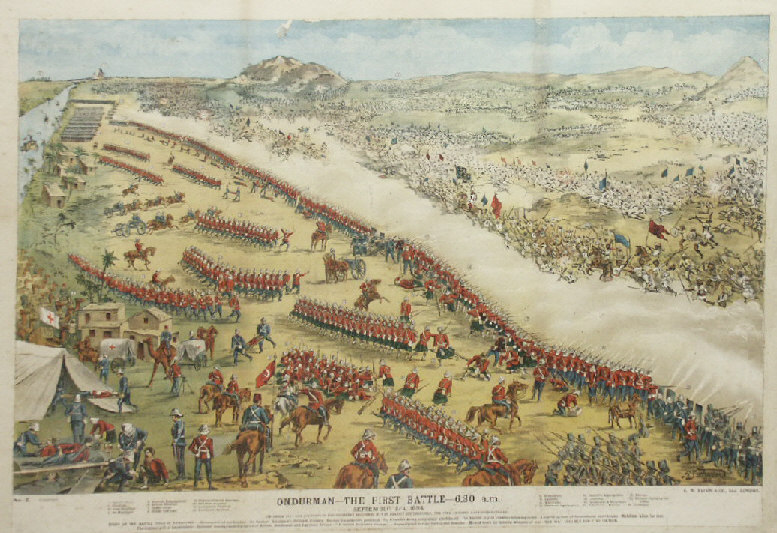
On the 2nd of September 1898 the Anglo-Egyptian Army, under Horatio Herbert Kitchener, met the Mahdist Sudanese Army (also known as the Dervishes) outside the town of Omdurman. The superior firepower of the Anglo-Egyptians devastated the Sudanese. Professor Toye refers to an estimate of 11,000 Sudanese dead and 16,000 wounded. 


The Battle of Omdurman, Sept 1898 (in actuality the British wore khaki)

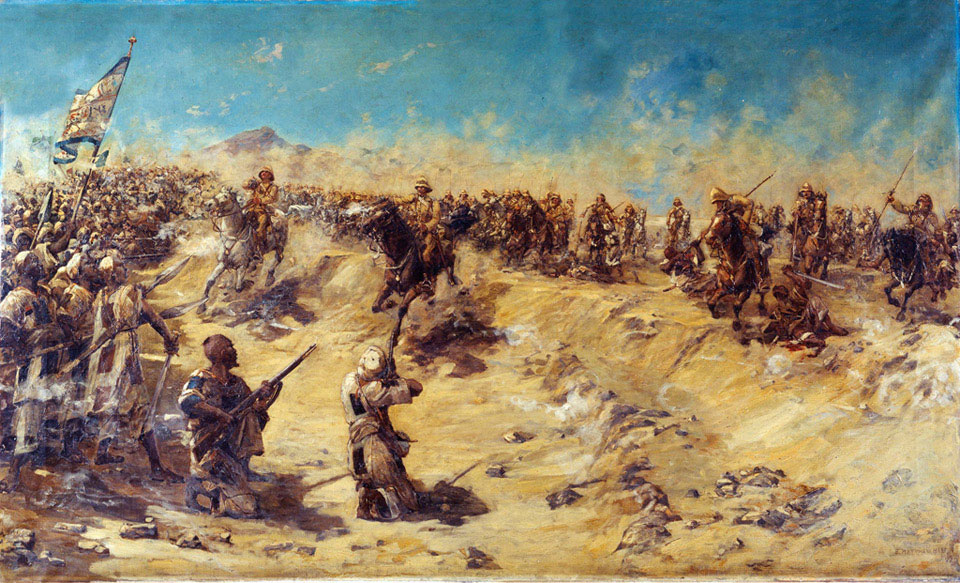
The 21st Lancers were ordered to harass the Dervishes and prevent them from retreating back to Omdurman. Churchill’s regiment came under musket fire from a party of Sudanese warriors. In his book, The River War, Churchill estimated that this party numbered no more than one hundred men strong. Colonel Roland Martin ordered the 21st Lancers to attack them and sweep them off the field of battle. 

The Charge of the 21st Lancers

What wasn’t apparent to the 21st Lancers was that a larger number of Dervish warriors – heavily outnumbering the 21st Lancers - were hiding in a dried-out watercourse out of their line of sight. The 21st Lancers charged right into them. The skirmish that followed was brief but brutal. To quote Churchill:  

The collision was prodigious. Nearly thirty Lancers, men and horses, and at least two hundred Arabs were overthrown. The shock was stunning to both sides, and for perhaps ten wonderful seconds no man heeded his enemy. Terrified horses wedged in the crowd, bruised and shaken men, sprawling in heaps, struggled, dazed and stupid, to their feet, panted, and looked about them. Several fallen Lancers had even time to re-mount. Meanwhile the impetus of the cavalry carried them on. As a rider tears through a bullfinch, the officers forced their way through the press; and as an iron rake might be drawn through a heap of shingle, so the regiment followed. They shattered the Dervish array, and, their pace reduced to a walk, scrambled out of the khor [watercourse] on the further side, leaving a score of troopers behind them, and dragging on with the charge more than a thousand Arabs. Then, and not till then, the killing began; and thereafter each man saw the world along his lance, under his guard, or through the back-sight of his pistol; and each had his own strange tale to tell.

Stubborn and unshaken infantry hardly ever meet stubborn and unshaken cavalry. Either the infantry run away and are cut down in flight, or they keep their heads and destroy nearly all the horsemen by their musketry. On this occasion two living walls had actually crashed together. The Dervishes fought manfully. They tried to hamstring the horses. They fired their rifles, pressing the muzzles into the very bodies of their opponents. They cut reins and stirrup-leathers. They flung their throwing-spears with great dexterity. They tried every device of cool, determined men practised in war and familiar with cavalry; and, besides, they swung sharp, heavy swords which bit deep. The hand-to-hand fighting on the further side of the khor lasted for perhaps one minute. Then the horses got into their stride again, the pace increased, and the Lancers drew out from among their antagonists. Within two minutes of the collision every living man was clear of the Dervish mass. All who had fallen were cut at with swords till they stopped quivering, but no artistic mutilations were attempted

The 21st Lancers suffered over a fifth of their number – 70 men out of 310 – killed or wounded. According to military historian Edward Spiers, these losses – and the losses of about 120 horses – were so heavy that they left the regiment effectively “out of action” (Spiers, "Campaigning under Kitchener", p.72)

Churchill gave a more detailed personal account in his later autobiography My Early Life and relays the circumstances in which he shot Dervishes: 

Straight before me a man threw himself on the ground. The reader must remember that I had been trained as a cavalry soldier to believe that if ever cavalry broke into a mass of infantry, the latter would be at their mercy. My first idea therefore was that the man was terrified. But simultaneously I saw the gleam of his curved sword as he drew it back for a ham-stringing cut. I had room and time enough to turn my pony out of his reach, and leaning over on the off side I fired two shots into him at about three yards. As I straightened myself in the saddle, I saw before me another figure with uplifted sword. I raised my pistol and fired. So close were we that the pistol itself actually struck him. Man and sword disappeared below and behind me. On my left, ten yards away, was an Arab horseman in a bright-coloured tunic and steel helmet, with chain-mail hangings. I fired at him. He turned aside. I pulled my horse into a walk and looked around again [emphasis added].

Churchill also wrote that he shot at a fourth man:

The other three troops of the squadron were re-forming close by. Suddenly in the midst of the troop up sprung a Dervish. How he got there I do not know. He must have leaped out of some scrub or hole. All the troopers turned upon him thrusting with their lances: but he darted to and fro causing for the moment a frantic commotion. Wounded several times, he staggered towards me raising his spear. I shot him at less than a yard. He fell on the sand, and lay there dead. How easy to kill a man!

What exactly was Churchill supposed to do? Let himself get hacked to death by swordsmen? Let himself get impaled by a spear? Complaining that Churchill killed several Sudanese warriors is completely unreasonable. Of course, he killed them. He was a soldier, they were soldiers, and they were all fighting for their lives. Had Churchill not killed them, they would have killed him. Killing is par for the course in a battle. 

Far from behaving in a disreputable manner, Churchill’s conduct was praised at the time. Douglas S. Russell notes that:

In his combat in his third war, Churchill comported himself very capably, showing his characteristic dash and indifference to danger. Trumpeter A. Norris of A Squadron later recalled: ‘Mr Churchill was in command of my troop and I must say that he was a daring and resourceful soldier… I saw him firing away for all he was worth.’ The regimental magazine of the 21st Lancers, The Vedette, referred to Churchill as a ‘very cool-headed young officer’… (Douglas S. Russell, Winston Churchill: Soldier, p.225).

Incidentally, contrary to Hirsch’s claim that this incident isn’t well known because none of the films about Churchill show it, the charge of the 21st Lancers is depicted in the 1972 film Young Winston.


This isn’t a particularly obscure film either. The BBC tends to air it every few years. 

A Victory Disgraced

The aftermath of the Battle of Omdurman proved controversial. Kitchener was criticized for allegedly abandoning the Dervish wounded and making no effort to provide them with medical assistance. Furthermore, it was claimed that Kitchener had ordered Anglo-Egyptian troops to killed wounded Dervishes on the spot. Leading the charge against Kitchener was The Westminster Gazette correspondent Ernest Bennett (Cecil, “British Correspondents”, pp.120-1). Kitchener flatly denied the accusations against him. He had his supporters. Another war correspondent (and veteran of the American Civil War on the Confederate side) called Bennet Burleigh devoted a postscript in his own book denouncing Bennett. Another defender of Kitchener was a member of the Royal Prussian General Staff, Capt. Adolf von Tiedemann, who was with Kitchener throughout the battle. 

An uninformed reader might think, on the basis of Hari’s review, that Churchill must have backed Kitchener to the hilt, and either covered up the massacre and neglect of the wounded Sudanese or justified it. This is not the case. Professor Toye says that the sight of the dead and dying Dervishes strewn across the landscape in the aftermath of the battle did affect Churchill. Contrary to Hari and Hirsch it did not cause any feelings of joy though. Churchill wrote that his sense of victory faded and was overtaken by a “mournful feeling of disgust” (quoted in Toye, Churchill's Empire, p.55). Churchill also wrote:

there was nothing dulce et decorum about the Dervish dead. Nothing of the dignity of unconquerable manhood. All was filthy corruption. Yet these were as brave men as ever walked the earth. The conviction was borne in on me that their claim beyond the grave in respect of a valiant death was as good as that which any of our countrymen could make. The thought may not be original. It may happily be untrue. It was certainly most unwelcome (quoted in Toye, Churchill's Empire, p.55)

I couldn’t find anywhere in Toye’s book where he says that Churchill “bragged” or boasted that he shot three Dervishes. I am not sure where Hari found this. Given his track record though it is quite possible that Hari just made it up out of whole cloth.

Churchill was quite proud that his own unit took prisoners alive rather than killing them outright:

I rejoice for the honour of the British cavalry when I reflect that they held their heads very high and that the regiment that suffered by far the greatest loss also took the greatest number of prisoners(quoted Douglas S. Russell, Winston Churchill: Soldier, pp.232-233).

Pretty much every writer has recorded that Churchill was appalled by the callous and brutal treatment of enemy wounded (e.g. Gilbert, Churchill: A Life, p.99; James, Churchill and Empire, p.10). In a letter to Ian Hamilton on the 16th of September 1898, Churchill wrote:

I am in great disfavour with the authorities here. Kitchener was furious with Sir E. Wood for sending me out and expressed himself freely. My remarks on the treatment of the wounded – again, disgraceful – were repeated to him and generally things have been a little unpleasant. He is a great general, but he has yet to be accused of being a gentleman (quoted Russell, Winston Churchill: Soldier, p.233).

After the war, in a letter to his mother, he referred to the victory at Omdurman as being “disgraced by the inhuman slaughter of the wounded” (quoted in James, Churchill and Empire, p.10)

Professor Toye doesn’t contradict any of this. In fact, he even says explicitly that in the aftermath of the battle Churchill was upset by the “maltreatment of the wounded and the desecration of the Mahdi’s tomb” (quoted in Toye, Churchill's Empire, p.56). It frankly boggles the mind that Hari missed this part of Toye's book. 

The only hint of criticism Toye levels at Churchill is that he thinks that after the war Churchill pulled his punches when it came to criticizing Kitchener. Maybe so, although I personally was not persuaded by all of Toye’s evidence. To take one example, the criticisms of Kitchener in The River War are described as being “modest” by Toye. Perhaps they seem modest to Professor Toye but they didn’t seem so to all reviewers at the time. Professor Toye even references one review in The Star which was subtitled “Churchill’s Severe Criticism of Lord Kitchener” (Toye, Churchill's Empire, p.331; emphasis added).

Conclusion

Hari and Hirsch’s tactics are a classic example of selectivity in fact being mixed with a downright untruth. They state that Churchill killed three Sudanese people. This is correct, he did. But they leave out that this was in the midst of a brutal skirmish and that the people he shot were armed warriors who would have tried to kill him if he didn’t shoot them first. There is nothing unethical or problematic in what Churchill did at the Battle of Omdurman. 

The suggestion that Churchill enjoyed killing those warriors is misleading. Hari’s claim that he “bragged” about it afterward doesn’t appear in the book Hari reviewed. That same book records Churchill as saying he had a feeling of “disgust” at the sight of dead and dying Dervishes. It is well known that Winston was appalled by the mistreatment of wounded Dervishes, referring to it as a “disgrace” in his correspondence.

Hari and Hirsch present Churchill at Omdurman as being at his imperialist worst. In truth, Churchill’s behaviour there was him at his humanitarian best.  

 Bibliography

Cecil, Hugh, "British Correspondents and the Sudan Campaign of 1896-98" in Edward M. Spiers (ed.), Sudan: The Conquest Reappraised (Frank Cass, 1998), pp.102-127

Churchill, Winston, The River War: An Account of the Reconquest of the Sudan (1902 Edition)

Churchill, Winston, My Early Life: A Roving Commission (Thornton Butterworth, 1931)

Gilbert, Martin, Churchill: A Life (Pimlico, 2000)

Hyam, Ronald, "Winston Churchill's First Years in Ministerial Office, 1905-1911" in Ronald Hyam, Understanding the British Empire (Cambridge University Press, 2010), pp.299-318

James, Lawrence, Churchill and Empire: Portrait of an Imperialist (Weidenfeld & Nicholson, 2013)

Roberts, Andrew, Churchill: Walking with Destiny (Penguin, 2019)

Russell, Douglas S., Winston Churchill: Soldier: The Military Life of a Gentleman at War (Conway, 2005)

Spiers, Edward M., "Campaigning Under Kitchener" in Edward M. Spiers (ed.), Sudan: The Conquest Reappraised (Frank Cass, 1998), pp.54-81

Toye, Richard, Churchill's Empire: The World That Made Him and the World He Made (MacMillan, 2010)

Friday, May 21, 2021

Greek Tragedy

 In 2014 The Observer published an article headlined “Athens 1944: Britain’s dirty secret”. The authors alleged that in December 1944 British troops shot and killed unarmed civilian demonstrators on the streets of Athens, Greece. The subtitle of the article states:

When 28 civilians were killed in Athens, it wasn’t the Nazis who were to blame, it was the British. Ed Vulliamy and Helena Smith reveal how Churchill’s shameful decision to turn on the partisans who had fought on our side in the war sowed the seeds for the rise of the far right in Greece today

And the caption under one of the photographs says:

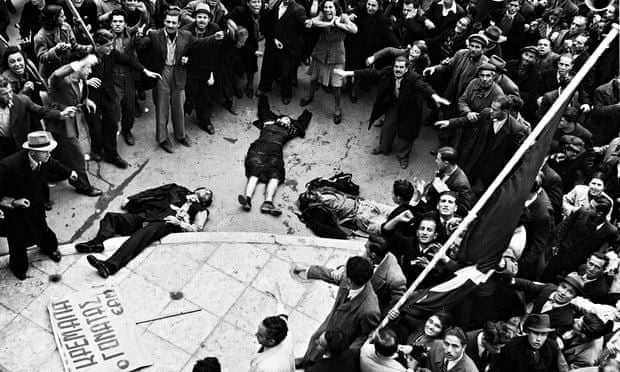
A day that changed history: the bodies of unarmed protestors shot by the police and the British army in Athens

A few paragraphs into their article the authors write:

This was the day [3rd of December 1944], those 70 years ago this week, when the British army, still at war with Germany, opened fire upon – and gave locals who had collaborated with the Nazis the guns to fire upon – a civilian crowd demonstrating in support of the partisans with whom Britain had been allied for three years.

Thus, was born another element of the Churchillian Black Legend – Winston Churchill's massacre of innocent Greek civilians. 

Contrary to what The Observer says, these people were not killed by British soldiers.

The article appeared, on the surface, to be credible. It was written by two distinguished journalists: Ed Vulliamy, a notable war reporter, and Helena Smith, the Guardian’s correspondent for Greece, Turkey, and Cyprus.  They cite several experts on Greek history and also interviewed eyewitnesses of the event. Therefore, it isn’t surprising that their article has been very influential. Indian politician and writer Shashi Tharoor wrote in the Washington Post that:

This week’s Oscar rewards yet another hagiography of this odious man [Churchill]. To the Iraqis whom Churchill advocated gassing, the Greek protesters on the streets of Athens who were mowed down on Churchill’s orders in 1944, sundry Pashtuns and Irish, as well as to Indians like myself, it will always be a mystery why a few bombastic speeches have been enough to wash the bloodstains off Churchill’s racist hands (emphasis added).

 The reference to “Greek protestors” links to the article by Vulliamy and Smith. 

The Indian news channel WION (World is One News) summarised the events thus:

In the year 1949 [sic], Churchill ordered the British army to fire on the anti-Nazi protestors in Greece...

If you google “Churchill Athens”, Vulliamy and Smith’s essay is the top suggestion out of 4,280,000 results. 

There is one problem with the allegation – it is completely untrue.

Fake News

Almost four months after that Vulliamy and Smith’s article was published, Stephen Pritchard was compelled to write a follow-up. This later article proves that the lurid account of British troops gunning down protestors was false. According to Pritchard, after Vulliamy and Smith’s article was published:

Seven Greek historians protested. They said the British had not fired on the crowd, but that Greek police certainly had, and that to present the December confrontation as one fought between the British alongside supporters of the Nazis against the partisans was “a gross misrepresentation” (emphasis added).

This isn’t a controversial point. No one before Vulliamy and Smith had ever claimed that the British Army shot at a civilian crowd on the 3rd of December 1944. Greek police certainly did, but there was no British involvement in that massacre. It frankly boggles the mind that this accusation passed even the most basic fact-check review. 

What followed after this protest by historians is quite revealing as to Weltanschauung of The Observer:

The following week, I ran a clarification, noting the protest by the seven and pointing out that Greek police were also likely to be among those who shot the 28 protesters. I recognise now that it was plainly inadequate in addressing concerns about the article (emphasis added).

So, after being told that they were flat out wrong about British troops killing Greek protestors, The Observer doubled down, merely suggesting that it was “likely” that Greek police were also involved in the shootings. This crosses the line from being reckless with the facts to being deliberately dishonest. The Observer was so keen to portray British troops in a negative light that they just assumed their involvement in the shooting. The slander was allowed to remain in the article despite numerous experts correcting the paper.

The blame for this misinformation shouldn’t fall on the elderly eyewitnesses quoted by Vulliamy and Smith. There were understandable reasons why they misremembered who was responsible for the shooting.

He [historian André Gerolymatos] wrote: “Did the British open fire on the demonstrators on 3 December 1944? The answer is no, but that reality is filtered through perceptions clouded by a day filled with violence and considerable confusion.

“The British did make an effort to peacefully disperse part of the crowd. One explanation is that some protesters easily mistook the use of tracer shells by British armoured units, fired over the heads of the demonstrators, as being directed at them. Another issue that further complicated matters was that the Greek soldiers wore British battledress, as did the Greek gendarmerie. Furthermore, there were American and British soldiers on the roof of the Grand Bretagne Hotel, observing the spectacle. For those on the ground it could have appeared that the gunfire from the police could have been mistaken as originating from the soldiers on the roof of the hotel. Although the police wore grey, they were in concealed positions on the balcony, roof, windows, and behind a wall in front of the police headquarters, making it difficult for the demonstrators to identify whether they were police or soldiers.”

The responsibility for the error lies with Vulliamy and Smith, who apparently did not bother to check this claim to see if it was correct. The Observer is at fault as well. They did not fact-check the article before publication, and they kept it online without removing the allegations. Unless a reader spots the link to Pritchard's article (which they euphemistically call a “column by the readers’ editor”) they will have a completely wrongheaded view of the events of the 3rd of December 1944. As this “readers’ editor” column has been shared a mere 59 times while the original essay has been shared 31,073 times, I suspect that the overwhelming majority of readers have been misled by the article. 

The Observer added a correction at the bottom of Vulliamy and Smith's article, but even that is misleading. It implies that it was possible that Greek police also fired on the protestors along with British troops, instead of saying that no British troops were involved:

A group of Greek historians writes concerning this article. It was reported that British troops opened fire on the Greek demonstrators from the Grande Bretagne hotel in Athens on December 3 1944. The hotel was British military headquarters, but the fire from it could also have come from Greek police.

What Actually Happened in Athens

On the morning of the 3rd of December 1944, a large demonstration took place in Athens. This demonstration was mainly left-wing, consisting of ‘communists, socialists, republicans, and antimonarchists’. According to the late André Gerolymatos, a Professor of Hellenic Studies at Simon Fraser University, some people were coerced into attending. The National Liberation Front (EAM) had previously announced that anyone who stayed away would be regarded as an “enemy of the people and dealt with accordingly (Gerolymatos, International Civil War, pp.100-101).

Greek police had cordoned the entrances to the city centre but a number of protestors broke through and advanced to the police station located near the Grande Bretagne Hotel. This was the headquarters of the Allies, i.e., the British. Gerolymatos actually is fairly understanding of the police and makes it clear that this incident wasn’t just an example of far-right Nazi collaborators butchering innocent left-wing protestors:

The policemen had every reason to fear for their lives: as they had served under the jurisdiction of the occupation authorities, the majority of Athenians had, rightly or wrongly, labeled them collaborators. Although many Greek police officials had covertly assisted the resistance and the allies, not enough time had passed since liberation to permit a clear distinction between absolute traitor and patriot. Indeed, some had had to wear the mask of the former in order to assist the latter.

Making matters worse, the Greek government failed to purge the security establishments and civil service of collaborators, whose continued presence now tainted every state official. The government had argued that time was required to conduct a meticulous and judicious purge, but such reasoning was lost on the crowds advancing toward the center of the city in the morning of 3 December 1944. To the half-starved population of Greece, symbols truly mattered, and the gray uniforms of the police invoked the fear and agony of the occupation

The handful of policemen positioned a few yards beyond their station were aware of this reality, and for the previous several hours they had witnessed dozens of wounded fellow officers being carried off on stretchers into the station following clashes with groups of demonstrators. As the crowd got closer and closer, the policemen’s fears turned to panic, and some began to replace their blank rounds with live ammunition.

When the crowd advanced to less than one hundred yards from the police cordon, suddenly a man in military uniform ran out of the station and shouted, “Shoot the bastards!” He then dropped to one knee and began firing his gun. A few seconds later the panic-stricken policemen followed suit.

They did not fire in unison like a disciplined unit, but discharged their weapons sporadically. Some of the officers hesitated for a few seconds; others had remained transfixed by the spectacle before them, but one after another they began to return fire. The first ranks of the crowd fell forward; the fortunate ones found protection behind trees or nearby walls, but most simply lay flat on the ground.

The shooting continued for approximately half an hour, and when it was over twenty-two of the demonstrators remained still, twelve of them dead (Gerolymatos, International Civil War, pp.104-105).

Gerolymatos is one of the experts cited by Vulliamy and Smith, and he is unequivocal that it was Greek policemen who shot demonstrators on the 3rd of December, not British soldiers. 

Mark Mazower, Professor of History at Columbia University and another expert cited by Vulliamy and Smith, also wrote that it was Greek police, not the British Army, who fired on protestors:

Shortly before 11 a.m., as thousands of EAM demonstrators entered Constitution Square, several policemen panicked and fired directly into the crowd from the police station which stood at one corner of the square. People fled, but it was discovered later that at least ten had been killed and over fifty injured. The initial reaction of the British 23rd Armoured Brigade, whose men moved in and cleared the square, was that the Greek police had lost their nerve: they had 'dealt rather wildly with the demonstration' and had 'fired unnecessarily' (Mazower, Inside Hitler’s Greece, p.352).

The shooting outraged left-wingers in Athens. Gerolymatos notes:

By noon, a second wave of demonstrators broke through the police cordons and was soon joined by thousands more, until the square was jammed with almost 60,000 people.11 The police retreated to their station and locked themselves inside. Over the next thirty minutes, the remaining police barricades disintegrated as most of the officers discreetly left the scene and sought refuge in nearby private homes or managed to reach the safety of the police headquarters. A few police stragglers near the square, however, were not as fortunate. They were seized by dozens of hands, punched, kicked. and spat upon. Their protestations of innocence were drowned out by a torrent of verbal abuse. The lucky ones were dragged off to the nearest lamppost and lynched; some, however, could not be pried away from the clutches of the mob, which, intoxicated by raw animal savagery, tore the men literally from limb to limb (Gerolymatos, International Civil War, p.105)

You know things are bad when being lynched makes you one of the lucky ones!

The next day shooting took place throughout the city between ELAS – EAM’s Paramilitary wing - and the police, and between ELAS and their political opponents.  By mid-afternoon ELAS had captured most of the police stations in Athens. Usually, police officers who surrendered were summarily executed by ELAS insurgents, either by being shot or hanged. Gerolymatos mentions one particularly gruesome incident:

In Piraeus, a British unit attempted to interpose itself between a police station and ELAS, but faced overwhelming opposition. After a tense verbal exchange, the guerrillas dragged out several of their prisoners and in front of the British soldiers proceeded to gouge out the eyes of these hapless prisoners. The British soldiers gawked, transfixed by the horror unfolding before them and disgusted by their impotency to interfere. The screams of the policemen reverberated along the empty streets, and were quickly reduced to low guttural moans, but the ordeal was far from over. For a few minutes, the ELAS executioners just grinned while savoring the spectacle of torment and the vulnerability of the British. Then, they took out butcher’s cleavers and began to hack off the forearms of the blind policemen and continued slashing until the bodies resembled heaps of human pulp. The agony, for victims and spectators, ended when the policemen were put out of their misery by bullets to their brains. The tormentors exploited such sadistic brutality on several levels—by exercising of their total superiority over their victims, and by forcing the British to observe the atrocity they made them de facto participants (Gerolymatos, International Civil War, p.108).

Churchill received updates on the situation in Athens throughout the 4th of December. That night he telegraphed the commander of British forces in Greece, Lt Gen Ronald Scobie: 

Do not hesitate to fire at any armed male in Athens who assails the British authority or Greek authority with which we are working….Do not hesitate to act as if you were in a conquered city where a local rebellion is in progress….It would be a great thing for you to succeed in this without bloodshed if possible, but also with bloodshed if necessary (quoted in Gilbert, Churchill, p.807; emphasis added).

Churchill was not in favour of shooting at civilian protesters. He was ordering the British Army to put down a communist insurgency. The telegram to Lt Gen Ronald Scobie was inadvertently shared with the US authorities (one of Churchill's Assistant Private Secretaries, Jock Colville, neglected to write the codeword ‘Guard’ on it which would have prevented it from being shared). The Americans leaked it to the press which led to a political storm for Churchill (Roberts, Churchill, p.850).

A paratrooper takes cover during fighting in Athens, Dec 1944

Fighting with communist insurgents was, at that time, controversial given the role communist partisans played in the fight against the Germans. It even led to a vote of no confidence in Churchill on the 8th of December, although Churchill won it comfortably at 279-30. 
Churchill's statements show that his motivation was the defence of democracy in Greece, not thwarting democracy. 

Democracy, I say, is not based on violence or terrorism, but on reason, on fair play, on freedom, on respecting other people's rights as well as their ambitions. Democracy is no harlot to be picked up in the street by a man with a tommy gun. I trust the people, the mass of the people, in almost any country, but I like to make sure that it is the people and not a gang of bandits from the mountains or from the countryside who think that by violence they can overturn constituted authority, in some cases ancient Parliaments, Governments and States. That is my general description of the foundation upon which we should approach the various special instances on which I am going to dwell. During the war, of course, we have had to arm anyone who could shoot a Hun. Apart from their character, political convictions, past records and so if they were out to shoot a Hun we accepted them as friends and tried to enable them to fulfil their healthy instincts

This wasn’t the end of the matter for Churchill. The fighting in Athens continued throughout December and so he decided to go there to facilitate discussions between all Greek parties, including the communists, that could bring the conflict to an end (Gilbert, Churchill, pp.808-810). This was an extremely risky trip for him, and at several moments he was nearly killed by stray - or deliberate - gunfire. On Boxing Day (26th of December) the communists attended a conference with the other Greek parties. Churchill stayed in Athens until the 28th of December when he left for Naples. Unfortunately, the Greek parties failed to come to an agreement that would stop the fighting and the conflagration continued into January 1945.


The conference on Boxing Day


The Road to Civil War

Vulliamy and Smith repeat a common far-left allegation that Churchill's orders to defeat ELAS amounted to a betrayal of a British ally and inaugurated a devastating civil war in Greece, costing thousands of lives. Churchill's motivation is presumed to have been to reimpose an unpopular monarchy on the Greeks. The problems with this thesis are as follows: (1)  it oversimplifies Churchill's attitude to the Greek monarchy, (2) it ignores the events that preceded the December 1944 insurgency, and (3) it whitewashes communist atrocities.

Churchill and the Greek Monarchy

It is true that, during the Second World War, the monarchy was not popular with the Greek people. It is also true that Churchill was committed to reinstalling the monarch when Axis troops could be ejected from the country. However, Churchill accepted that the Greeks were within their rights to become a republic after the war. As he told the British ambassador to the Greeks, Rex Leeper:

The King is the servant of his people. He makes no claim to rule them. He submits himself freely to the judgement of the people as soon as normal conditions are restored. He places himself and his Royal House entirely at the disposition of the Greek nation. Once the German invader has been driven out, Greece can be a republic or a monarchy, entirely as the people wish (quoted in Gerolymatos, International Civil War,  pp.51-52).

The British government did not wish to reimpose the pre-war dictatorship on the Greek people. King George II of Greece was pressured to terminate it and restore the 1911 constitution, which he did in February 1942 (Gerolymatos, International Civil War,  p.47).

Communist Shenanigans

The Greek Civil War did not begin with the events of the 3rd of December 1944. In October 1943 ELAS started fighting with other resistance groups, notably the pro-monarchy EDES. ELAS’s offensives were quite successful although it was unable to fully eradicate the other groups (Gerolymatos,International Civil War, pp. 86-87). While the fighting between Greek resistance groups ended in February 1944 with the Plaka Agreement, the political disagreements between the different organisations were not resolved. The conflict was merely frozen.

In March 1944 EAM set up the Political Committee of National Liberation (PEEA). This organisation represented an alternate government to the Government in Exile. Shortly afterwards PEEA sympathisers in the Greek forces in the Middle East mutinied. Churchill blamed the communists for this, and it soured his attitude toward them (Gerolymatos, International Civil War, p.90). In May 1944 the Greek Premier, George Papandreou chaired an all-party conference in Lebanon aimed at establishing a government of national unity, bringing EAM into the fold. The resulting charter was accepted by EAM, ELAS and PEEA delegates, as well as the King. However, EAM and ELAS soon changed their minds and refused to join the government. It took the intervention of the Soviets, who were concerned that EAM and ELAS were undermining Allied unity, for them to eventually agree to join the government (Gerolymatos, International Civil War, pp.92&96)

By this point, Churchill, and other British officials, assumed that the communists would attempt to seize control of Greece when the Germans withdrew. As British Foreign Secretary, Anthony Eden, said on the 9th of August 1944:

Were the Greek Communist forces, who were strongly armed, to seize power, a massacre might follow. This would be very injurious to our prestige, and might even add Greece to the post-war Balklan Slav block which now showed signs of forming under Russian influence, and from which we were anxious to keep Greece detached” (quoted in Gerolymatos, International Civil War, p.98). 

Whitewashing Red Terror

Vulliamy and Smith gloss over atrocities by ELAS and the role they played in bringing about the Greek Civil War. ELAS was brutal, and not just to Germans or to Greek collaborators. Political scientist Stathis N. Kalyvas has written the following on the actions of ELAS from the autumn of 1943 onwards:

Although some of the victims, particularly in the towns, had been working for the German occupation authorities, the great majority had not. Indeed, they were described by EAM cadres as “reactionaries” rather than “traitors”. They were typically notables: mayors, doctors, merchants, petty officers, that is, individuals who were seen as both potentially disloyal to the EAM cause and able to influence many villagers. Their potential disloyalty was connected to what were rather trivial issues: traveling to a (German-occupied) town too often, hiding or refusing to hand in a gun, refusing to pay a tax or perform some duty requested by EAM, criticizing EAM or even poking fun at a local EAM member in the coffee shop, and so on (Kalyvas, 'Red Terror', p.148).

The predictable result of such violence was that people either joined or gave support to the collaborationist Security Battalions. To quote Kalyvas:

The role of the kin of EAM’s victims is central in understanding the wave of terror launched by the Security Battalions. As soon as they realized that the Security Battalions were willing to help them overthrow EAM in their villages, the victims’ kin lobbied the SB to organize raids and supplied the Battalions with crucial information about the EAM organization of their villages. More than sixty years later, many among these people have no qualms about their actions, which they view as either just retribution for the distress suffered under EAM rule or as the inevitable result of the only defense that was available to them. For instance, a man whose parents had both been killed by EAM before he joined the Security Battalions, told me: “I went to the Germans. What should I have done since there was no one else to turn to?” (Kalyvas, 'Red Terror', p.151).

Gerolymatos writes about the activities of one ELAS commander called Veloukhiotis:

ELAS was also beginning to lose popularity because of the hardships endured by the mountain villages. Veloukhiotis, in particular, exacted terrible vengeance upon any villager suspected of aiding the enemies of ELAS—not just the Germans. Often, he even forced members of the AMM to watch helplessly as he tortured a simple peasant for some minor offense. In the village of Mavrolithary, ELAS arrested fourteen men simply because they belonged to a rival band. The punishments, designed to set an example for all the local inhabitants, usually took place in the village square and set the pattern of death and degradation that continued until 1949. On this occasion, Veloukhiotis’ henchmen grabbed the first prisoner and stripped him of his clothes. Then in front of the villagers, they tied the man to a table, spread eagle. The victim quickly realized what was in store and vainly pleaded for mercy. In a few minutes, his shrill cries reverberated in the village square as the executioner, splattered with blood, slowly proceeded to hack away at the man’s body, pausing enough for each blow to take effect and prolong the process for as long as possible. The savagery went on until a British officer present pulled out his revolver and terminated the man’s agony. Veloukhiotis, shaking with anger, had to be restrained from killing the officer (Gerolymatos, International Civil War, pp.88-90)


Conclusion

The claim that Churchill ordered British troops to fire on an unarmed protest in Athens on the 3rd of December 1944 is baseless. Greek police, not British soldiers, shot at a demonstration that day. They did so for their own reasons, and not because they were following Churchill's orders. After the massacre, there was widespread fighting throughout Athens and Churchill ordered the British Army to put down the insurgents. Churchill was not attempting to crush democracy, but to save it from what appeared to him to be a communist coup d'état.  

While the massacre of the demonstrators was appalling, it is misleading to describe it as marking the beginning of the Greek Civil War. The first phase of the civil war began over a year earlier when the communist resistance group ELAS attempted to destroy other resistance organisations. ELAS acted with such savagery that it drove many people into the arms of the German occupiers. Between that, and EAM's shenanigans throughout 1944 to oust the Greek government-in-exile, it is hard to take seriously the claim that Churchill stabbed an ally in the back in December 1944. 

Churchill deserves credit though for travelling to Athens - at great personal risk - to facilitate a conference that would bring the warring parties together. It might have ended the fighting, and so Churchill was willing to risk his own life to secure peace. Unfortunately, while the conference took place, the Greek factions could not come to an agreement and so the war continued. 

Bibliography

Gerolymatos, André, An International Civil War: Greece, 1943 – 1949 (Yale University Press, 2016)

Gilbert, Martin, Churchill: A Life (Pimlico, 2000)

Kalyvas, Stathis N., 'Red Terror: Leftist Violence during the Occupation' in Mark Mazower (ed.), After the War Was Over: Reconstructing the Family, Nation and State in Greece, 1943 - 1960 (Princeton University Press, 2016), pp.142-183

Mazower, Mark, Inside Hitler’s Greece: The Experience of Occupation, 1941 – 44 (Yale University Press, 1993)

Roberts, Andrew, Churchill: Walking with Destiny (Penguin, 2019)


Fallacies of a Fundamentalist

Occasionally he stumbled over the truth, but hastily picked himself up and hurried on as if nothing had happened – Winston Churchill, 1936 (...